
Opening Theory in BigChess: Building Your Framework for the 10×10 Board

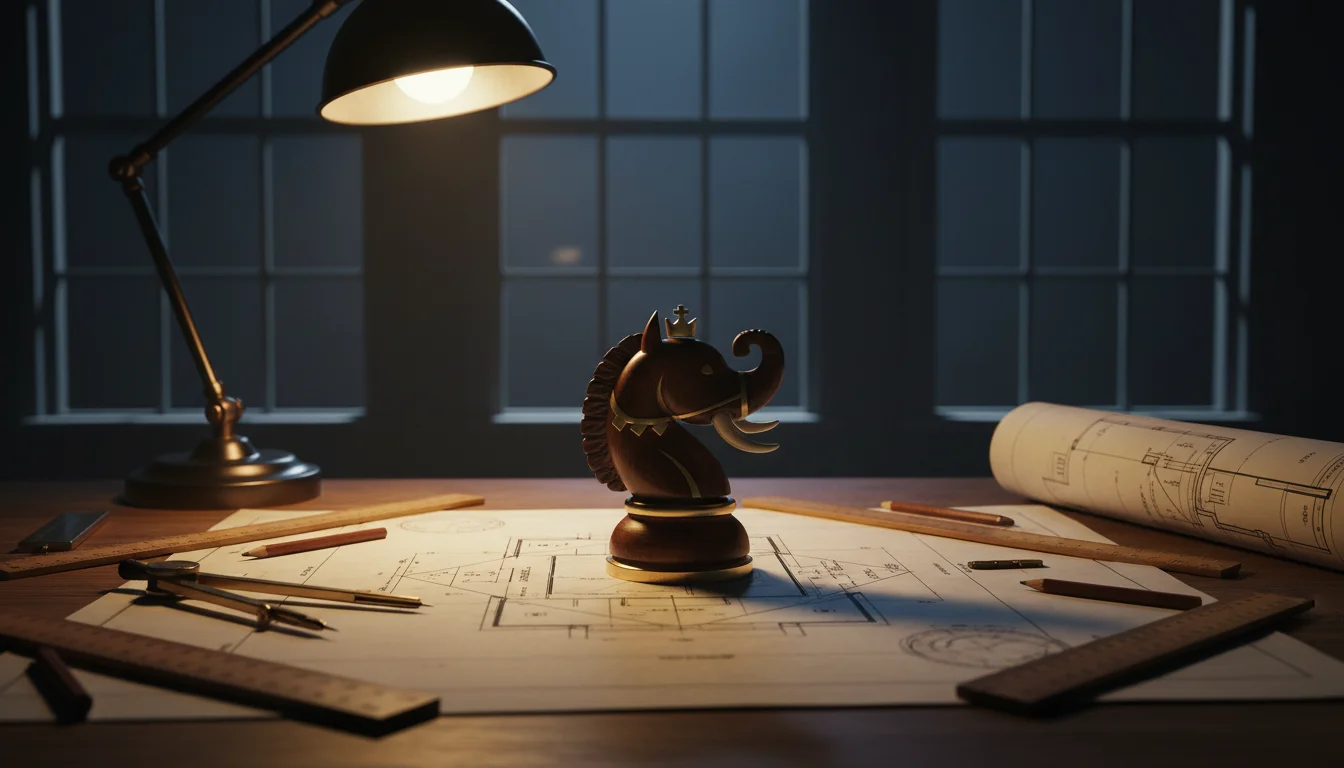
Opening Theory in BigChess: Building Your Framework for the 10×10 Board
Classical chess opening theory took centuries to develop and ultimately became a burden on creative play. BigChess starts fresh — and that is one of the best things about it.
Introduction: The Weight of History
Imagine sitting down to play chess and being told that the first twenty moves of your game have already been decided by millions of players, engines, and grandmasters before you. That the position you enter the middlegame with was mapped out decades ago. That deviating early from established lines puts you at a quantifiable disadvantage before you have even begun to think for yourself.
For many intermediate and advanced chess players, this is not imagination. It is reality. Classical chess opening theory has grown to a scale that is simultaneously impressive and oppressive. Opening databases contain hundreds of millions of positions. Grandmasters arrive at the board with twenty to thirty moves of preparation memorized for a dozen different opening variations. The opening phase of a high-level classical chess game can resemble a recitation more than a contest.
BigChess exists entirely outside this tradition. There is no established BigChess equivalent of the Sicilian Defense, the Ruy Lopez, the King's Indian, or the Nimzo-Indian. The 10×10 board with two Clone pieces per side has no opening canon that players can memorize. Every game begins in genuinely unexplored territory. The absence of opening theory is not a gap waiting to be filled — it is a feature that keeps BigChess a game of genuine thinking from the first move.
This article traces how classical chess opening theory developed, examines why its growth has become problematic for creative play, explains why BigChess opening theory is truly new ground even for expert chess players, and provides practical frameworks for BigChess players approaching the opening phase without a memorization scaffold.
Part I: How Classical Chess Opening Theory Was Built
The Earliest Masters: Play Before Theory (1500–1850)
The modern rules of chess stabilized around 1475–1500, when the queen received her current powers and pawns gained the two-square first move option (along with en passant). The game that emerged was dramatically faster and more tactical than medieval chess, and the early masters began publishing their observations almost immediately.
Ruy López de Segura, a Spanish priest, published a chess treatise in 1561 that analyzed openings beginning with 1.e4 e5. The opening now universally known as the Ruy Lopez — 1.e4 e5 2.Nf3 Nc6 3.Bb5 — bears his name not because he invented it (similar moves appear in earlier manuscripts) but because his systematic analysis of its continuations was among the first published. He was building theory.
Gioachino Greco, an Italian player of the early 17th century, compiled a collection of brilliancy games — most of them likely composed or edited by Greco rather than played — that circulated in manuscript form across Europe and established tactical motifs that master players studied for generations. These were not opening theory in the modern sense, but they were pattern libraries: catalogs of how certain openings led to certain types of middlegame positions.
The Romantic era players of the early 19th century — Anderssen, Morphy, Zukertort — played with little systematic opening knowledge by modern standards. Their strength lay in tactical creativity in the middlegame, not opening preparation. Morphy, widely considered the strongest player of his era, reportedly spent almost no time on opening study. He trusted his tactical ability to handle whatever positions arose from reasonable opening play.
Steinitz and the Positional Revolution (1870s–1890s)
Wilhelm Steinitz's contributions to chess theory fundamentally changed the nature of opening study. Steinitz articulated the positional principles that underlie sound chess play — pawn structure, piece activity, king safety, the accumulation of small advantages — and showed how these principles should guide opening choices.
Once you have a theory of what good chess positions look like, you can reason backward: what opening moves tend to produce those positions? Which openings give White (who moves first) the maximum chance to establish a structural advantage? Which responses for Black best neutralize White's first-move initiative?
This positional framework transformed opening study from a collection of tactical patterns into a coherent strategic discipline. Openings began to be evaluated not just by whether they led to sharp tactics, but by the pawn structures and piece configurations they produced — and whether those structures were favorable or unfavorable according to Steinitz's principles.
The Hypermodern Challenge (1920s–1930s)
Classical opening theory at the dawn of the 20th century emphasized the importance of occupying the center with pawns — 1.e4 or 1.d4, with the goal of establishing pawns on e4 and d4 (for White) or e5 and d5 (for Black). The center was the most important part of the board, and the best opening strategy was to seize it immediately.
The Hypermodern school, led by Richard Réti, Aaron Nimzowitsch, and Savielly Tartakower in the 1920s, challenged this orthodoxy. Their insight: you don't need to occupy the center with pawns to control it. You can control central squares with pieces from a distance, allow your opponent to build a classical pawn center, and then undermine it with timely pawn breaks and piece pressure.
This philosophical shift spawned an entire new generation of openings: the King's Indian Defense, the Nimzo-Indian, the Grünfeld Defense, the Catalan. These openings don't fight for the center immediately; they challenge it indirectly. Their addition to the opening canon doubled the theoretical burden on players who wanted to be prepared for everything.
The Computer Era and the Theory Explosion (1990s–Present)
Before computers, opening theory was limited by human analytical capacity. A grandmaster studying an opening worked through variations with a board and pieces, checking lines by hand, comparing with published games and analyses. Deep preparation meant knowing the main ideas and several key variations down to ten to fifteen moves.
Computer engines changed this completely. By the late 1990s, engines like Fritz and Crafty could analyze positions faster than any human and never blundered by miscounting material. By the 2000s, engines had become dramatically stronger than the best human players. A grandmaster with engine access could prepare specific opening variations with computer verification to twenty-five or thirty moves — far beyond what human calculation alone could achieve.
The consequence was the arms race that has characterized elite chess in the 21st century. To compete at the top level, players must have computer-prepared novelties — new moves within known openings that introduce unexpected problems for the opponent at specific points in well-analyzed variations. The opening phase became partly a competition to see whose preparation could go deeper and whose novelties could catch the opponent off guard.
Magnus Carlsen, in a much-discussed comment, said that one reason he preferred to avoid deeply analyzed opening variations was precisely to get out of preparation as quickly as possible and "play chess" — to reach positions where genuine calculation and understanding determined the result, rather than the depth of pre-game computer analysis. His preference for less-analyzed sidelines was a deliberate strategy to escape the theory trap.
Part II: The Costs of Opening Theory
The Memorization Problem
Opening theory has become so large that even professional chess players cannot learn all of it. A grandmaster competing at the highest level typically specializes in a relatively narrow opening repertoire — perhaps five to ten openings as White and a similar number as Black — and knows these deeply. Everything outside their repertoire relies on general principles and tactical alertness.
For club and amateur players, the memorization burden is even more problematic. Studying openings is widely recommended as one pathway to improvement, but the returns are sharply diminishing and the material is enormous. A player who spends a year memorizing opening theory has learned that year's worth of theory — but their tactical and strategic calculation ability, which is the skill that actually decides most amateur games, may have improved little.
The psychological cost is also significant. Players who have invested heavily in opening preparation become anxious when opponents deviate from expected lines. The theory comfort zone creates a theory anxiety zone: positions outside preparation produce not creative excitement but a kind of vertigo — the sudden awareness that you are on your own, without the map you spent so much time memorizing.
The Draw Problem
At the elite level, the depth of opening preparation contributes to the high draw rate that has concerned chess organizers for decades. When both players have studied a theoretically drawn variation with computer verification to twenty moves deep, and both follow that variation correctly, the game reaches an equal middlegame position that may be drawn with best play. The result is a "draw by repetition of theory" rather than a contest of skill.
Major tournaments have addressed this by experimenting with scoring systems that reward decisive results, or by using tiebreak criteria that favor fewer draws. These are workarounds for a problem that originates in the theory explosion itself. The more deeply analyzed the openings, the more likely elite games in those openings are to reach theoretically drawn positions before either player has had to think independently.
The Joy Problem
Perhaps the most important cost of opening theory for ordinary players is harder to quantify: it can remove the joy of discovery from the opening phase. If you have memorized the first fifteen moves of your favorite opening, the first fifteen moves of your game are not a chess experience — they are a performance. The chess experience begins afterward, in the middlegame, if you have memorized correctly. If you haven't, or if your opponent deviates, it begins earlier — in the mild panic of leaving the book and not quite knowing where you are.
This is not a healthy relationship with the game's opening phase. A game should be engaging from move one. The opening should feel like an interesting problem with multiple reasonable solutions, not a recitation followed by an exam.
Part III: Why BigChess Opening Theory Is Genuinely New
No Equivalent of the Sicilian Exists
The Sicilian Defense is the most popular response to 1.e4 in classical chess, played at every level from beginner tournaments to World Championship matches. It has been analyzed in thousands of books, hundreds of thousands of games, and by every major chess engine for decades. Its main variations — the Najdorf, the Dragon, the Scheveningen — have theory that extends thirty or more moves deep with near-engine-quality accuracy.
There is no BigChess equivalent of the Sicilian. There is no widely played, deeply analyzed response to the most common BigChess opening moves that any experienced BigChess player will recognize and have studied. Every BigChess opening situation is genuinely underexplored. Players cannot rely on accumulated theoretical knowledge for the simple reason that there is no accumulated theoretical knowledge to rely on.
This is simultaneously challenging and liberating. Challenging because players cannot fall back on memorized lines when uncertain. Liberating because every opening decision is a genuine strategic choice rather than a memory exercise.
Clone Placement Has No Precedent
In classical chess, every piece's starting position and typical early development are established by centuries of practice. Knights go to f3 and c3 (or their mirror squares for Black). Bishops develop to active diagonals. Rooks connect and occupy open files. These patterns are so deeply absorbed by experienced chess players that they feel almost like natural law rather than learned strategy.
The Clone piece has no established development patterns. BigChess players must determine from first principles:
- Should Clones be developed early, before the traditional minor pieces? Or late, into a prepared structure?
- Which squares constitute strong Clone outposts on a 10×10 board? The expanded center changes the geometry of outpost squares compared to classical chess.
- Should both Clones be developed to the same side, or should they be split across the board to create pressure on both wings simultaneously?
- When is it correct to initiate a Clone exchange, and when should Clone exchanges be avoided?
None of these questions has an established answer in BigChess theory, because BigChess theory is in its infancy. These questions must be answered through calculation, principle-based reasoning, and practical experience. This is exactly the kind of genuine strategic thinking that classical chess's opening theory increasingly displaces at the intermediate and advanced levels.
The Triple Pawn Advance Creates New Pawn Structures
Classical chess pawn structure theory is extraordinarily detailed. The resulting positions from every major opening have been classified, analyzed, and given proper names. The Sicilian Dragon pawn structure, the Isolated Queen's Pawn, the Carlsbad structure, the Maróczy Bind — experienced chess players recognize these structures instantly and have absorbed reams of information about how to handle them.
The triple pawn advance in BigChess — the option to advance a starting-rank pawn three squares on its first move — creates pawn structures that have no classical equivalent. A pawn that advances three squares from its starting rank on move one creates different tension with the central pawns, different candidate squares for pieces, and different pawn break options compared to any structure arising from the standard one-or-two-square first moves of classical chess.
Extended en passant — the rule that any square a triple-advancing pawn passed through is a valid en passant capture square — adds another layer of novelty. In classical chess, en passant is a well-understood tactical element with established patterns. In BigChess, a triple advance can create an en passant situation spanning two squares rather than one, requiring calculation of whether the extended en passant capture is tactically correct in the specific position.
No classical chess training prepares a player for these structures. They are genuinely new, and handling them well requires BigChess-specific strategic understanding that cannot be borrowed from any existing body of theory.
The 10×10 Center Is a Different Problem
Classical chess center theory focuses on the four central squares: e4, d4, e5, d5. Control of these squares — with pawns, pieces, or both — is the organizing principle of most classical opening systems.
The 10×10 board expands the meaningful center to at least nine squares, and arguably more. The geometric implications of a larger center are not merely that there are more central squares to contest but that the strategic character of center control changes. Pawns on the fifth rank (the classical occupation of the center) are further from their starting squares relative to the board than in classical chess, and pieces developed toward the center face a longer journey than they do on an 8×8 board.
This means that the principle "control the center with pawns and pieces early" remains valid in BigChess but its execution looks different. The optimal squares for central control are not identical to classical chess equivalents. The right pawn advances — whether one, two, or three squares, and in which files — create different central tension than in classical chess and require BigChess-specific understanding to navigate correctly.
Part IV: Practical Opening Principles for BigChess Players
Principle 1: Center Control Is Still the Organizing Priority
Despite the expanded board and the novelty of the Clone, the fundamental principle of classical chess openings applies in BigChess: control of the center provides piece mobility, pawn advancement opportunities, and the ability to shift forces quickly between flanks. A BigChess player who cedes central space without compensation will typically find their pieces less active and their game more reactive.
On the 10×10 board, central pawns on the e and f files (or their equivalents) provide natural outpost squares for pieces and control key squares that influence the entire board. Developing toward the center rather than to the wings in the opening is as valid a principle in BigChess as in classical chess.
Principle 2: Develop the Clone With Intent
The Clone is too valuable to develop passively. A Clone on its starting square, buried behind undeveloped pawns and pieces, is contributing little while the opponent establishes active positions. Early Clone development — placing it on a square where both its diagonal slide and its knight jumps are relevant to the central contest — should be a genuine opening priority.
Simultaneously, Clone development should serve the broader plan. A Clone developed solely to attack quickly, without regard for king safety or pawn structure, may create immediate threats but leave structural weaknesses that a careful opponent can exploit once the early tactical pressure is absorbed.
The balance — activating the Clone while maintaining structural coherence — is the central opening skill in BigChess that has no direct parallel in classical chess. Finding this balance through practical experience is the most reliable learning path.
Principle 3: Triple Pawn Step Decisions Require Concrete Calculation
The triple pawn advance is a significant opening option but not always the correct one. Before advancing a pawn three squares, a BigChess player should ask:
- Does this advance create an immediately attackable pawn? (An advanced pawn that cannot be defended easily may become a weakness.)
- Does this advance open a key diagonal for a Clone? (If yes, the tempo gain of the triple advance may be worth it even if the pawn becomes slightly exposed.)
- Does this advance contest the opponent's intended central formation, or does it leave important central squares uncontested?
- Does the extended en passant rule create any immediate complications? Can the opponent capture en passant in a way that disrupts my structure?
The triple advance is a tool with specific favorable applications, not a universal improvement over the double advance. Using it well requires calculating the specific consequences rather than applying it as a default option.
Principle 4: King Safety Comes First, Even on a Larger Board
The 10×10 board might tempt players to delay king safety, reasoning that attacks take longer to develop on the larger board and there is more time to castle. This reasoning is partially correct — attacks do take longer to organize on 10×10 than on 8×8 — but the Clone piece's ability to create threats from long distance via diagonal and to execute sudden knight jumps means that king safety remains an early priority.
Castling in BigChess sends the king three squares rather than two, landing on a slightly different square than in classical chess. The post-castling pawn structure — three pawns in front of the castled king — provides similar security to the classical castled position but requires attention to the specific diagonal patterns that a Clone can threaten from long range. Players who have castled must remain alert to Clone long-diagonal threats against their king's pawn cover in a way that has no direct classical parallel.
Principle 5: Leave Your Opponent With Problems, Not Just Good Moves
In classical chess, the concept of "leaving problems" — making moves that present your opponent with genuinely difficult decisions rather than moves that are clearly best but leave the opponent comfortable — is a key element of practical over-the-board play. Players who always play the "correct" move but never create complications end up in equal positions that they must convert through technique alone.
In BigChess, Clone placement decisions are exceptional "problem-leaving" tools. A Clone developed to a square that creates multiple simultaneous threats — diagonal pressure on one target plus a knight-jump threat to another — forces the opponent to address multiple concerns simultaneously. Structuring your opening play so that Clone development consistently creates these dual-threat situations is practical opening strategy of a distinctively BigChess character.
Principle 6: Study Games of Strong Players, Not Opening Books
In classical chess, opening books and databases are the primary resource for opening preparation. In BigChess, where opening books don't yet exist, the equivalent resource is the game history of strong players on the BigChess platform. Observing how top-rated BigChess players handle Clone development, pawn structure decisions, and the transition from opening to middlegame provides a practical opening curriculum that reflects actual BigChess practice rather than theoretical speculation.
BigChess's game history feature and leaderboard make the games of strong players available for study. This is the most valuable opening preparation resource currently available to BigChess players, precisely because it reflects real games rather than theoretical constructs.
Part V: The Advantage of Genuine Discovery
The First Generation of BigChess Opening Ideas
Every game of chess that has ever been played, from Chaturanga to the 2025 World Championship, was once part of a frontier. The first players to discover the power of a developed bishop, the value of a central pawn, the geometry of a knight outpost, were genuine discoverers. They were solving problems no one had solved before.
That frontier is mostly gone in classical chess. The opening principles that govern modern play were worked out over centuries. The specific variations have been analyzed by millions of players and engines. Playing a classical chess opening today means entering a tradition, not charting a course.
BigChess players are in the position of those early discoverers. Every BigChess game played today potentially reveals something about the game that no one has seen before. A Clone development idea that works well in practice, an effective response to the triple pawn advance, a useful pawn structure for the larger board — these are genuinely open questions. The BigChess community is collectively writing the opening theory of a new game, and every player who engages seriously with BigChess opening problems is contributing to that body of knowledge.
Being "Booked Up" Is Impossible — and That Is a Feature
In classical chess, a player who is "booked up" — who has memorized deeply and accurately in their opening repertoire — has a genuine edge over opponents who have not. The booked-up player is playing well-analyzed, computer-verified moves while their opponent is calculating from scratch. This advantage is real and significant.
In BigChess, no one can be booked up in this sense. The opening theory doesn't exist to memorize. Every player is calculating from scratch from near the beginning. The competitive advantage in BigChess openings goes not to the player who has memorized better but to the player who reasons better — who understands positional principles more clearly, who calculates Clone threats more accurately, who makes sounder structural decisions under genuine uncertainty.
This is, without qualification, a healthier form of opening play. It rewards the qualities that chess is supposed to develop — genuine thinking, pattern recognition, strategic reasoning — rather than the quality of having invested many hours in database study.
The era of genuine opening discovery that chess players can no longer experience in the classical game is alive and present in every BigChess opening. You are not following the theory. You are writing it.
Part VI: The Future of BigChess Opening Theory
How Classical Opening Theory Developed and How BigChess Theory Will
Classical chess opening theory did not arrive fully formed. It grew gradually from practical play — from games between strong players, from post-game analysis, from the gradual identification of patterns and principles that worked consistently. The first "theories" were descriptive observations: "playing this way tends to produce positions that are favorable." Over generations, these observations were refined, tested, systematized, and eventually deepened by computer analysis.
BigChess opening theory will develop the same way. As more games are played between strong players, patterns will emerge. Certain Clone development approaches will prove consistently more effective than others. Certain responses to the triple pawn advance will be identified as sound or unsound. Pawn structures that arise frequently in well-played BigChess games will be studied and named.
Engine analysis — through the Fairy-Stockfish engine that supports BigChess — will eventually contribute systematic opening evaluations, identifying which BigChess opening approaches are objectively strongest. But this process will take years of serious play to accumulate the game database that makes engine analysis of opening positions meaningful.
The Value of Being an Early Practitioner
Players who engage seriously with BigChess openings today are not just learning a game — they are participating in the formation of a game's theoretical tradition. The BigChess opening ideas that prove correct and practical, that are adopted by the community because they work, will carry the names and reputations of the players who developed and demonstrated them.
Classical chess had its Ruy Lopez, its Nimzowitsch, its Grünfeld. BigChess will have its own theoretical heroes, and those heroes are playing right now — exploring the 10×10 board, learning what the Clone can do, and building the foundations of an opening theory that will serve the game for generations.
Conclusion: The Empty Map Is an Invitation
Classical chess opening theory is a monument to human intellectual achievement — centuries of accumulated wisdom about the best way to begin a game of chess. It is also, for many contemporary players, a burden: an expectation of memorization that substitutes recall for creativity, preparation for calculation, and database knowledge for genuine understanding.
BigChess offers a different relationship with the opening. Not ignorance — the principles of good chess still apply — but genuine freedom. Freedom to think from move one. Freedom to try ideas that no engine has evaluated because no engine has been applied to BigChess openings for the thousands of hours it would take to produce reliable opening theory. Freedom to discover.
The Clone is waiting on c1 and h1. The 10×10 board is open. The theory hasn't been written yet. That is not a problem. That is the point.
Start writing your own BigChess opening theory today. Play now at bigchessgame.com — available on iOS, Android, and web browser. On a 10×10 board with two Clones per side, the opening is yours to explore.
About the Author
Rinat Fatalov
Co-inventor of Big Chess
University Student, Co-inventor of Big Chess, First Category chess player.