
Chess Variants

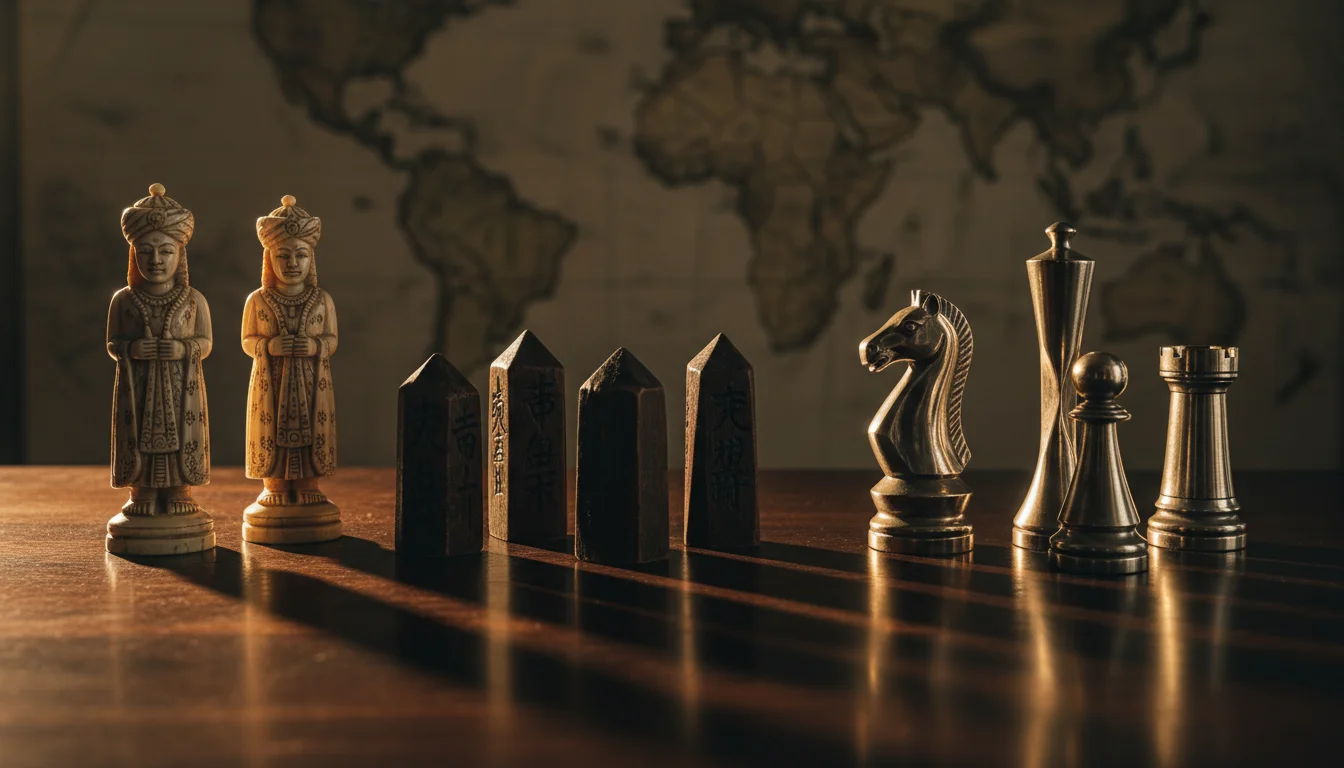
Chess Variants: A World of Strategic Possibilities — and the Rise of BigChess
From ancient battlefields to modern screens, chess has never stopped evolving. Here is a journey through the most fascinating variants of the game — and an introduction to BigChess, the 10×10 variant that takes everything you know and expands it.
The Game That Never Stood Still
Chess is one of the oldest strategy games in recorded history, yet it has never been a single, fixed thing. For as long as people have played it, they have also reinvented it — changing the board, adding pieces, tweaking the rules, experimenting with new objectives. The result is a sprawling family of games that share a common ancestor but diverge in fascinating directions.
Today, hundreds of chess variants are played around the world. Some are thousands of years old, regional traditions that evolved in parallel with the Western game. Others are recent inventions born from a desire to fix perceived flaws in the classical game, or simply to explore new strategic territory. And a few are genuine leaps forward — expansions that open up entirely new dimensions of play.
This article takes you on a tour of that landscape. We will look at the historical variants, the modern digital favourites, and the lesser-known experiments. And we will spend the most time on BigChess — a 10×10 variant that introduces the Clone, a brand-new piece unlike anything in the history of the game.
Part One: Ancient Roots — Where Chess Comes From
Chaturanga: The Origin
Every chess variant alive today traces its lineage to a single game: Chaturanga, played in India during the Gupta Empire, likely around the 6th century CE. The name comes from the Sanskrit for “four divisions of the military” — infantry, cavalry, war elephants, and chariots. Each of these military divisions became a piece type on the board.
Chaturanga was the first game in recorded history to combine two features that define all chess descendants: pieces with different powers, and a single royal piece whose fate decided the outcome of the game. These two ideas — asymmetric pieces and the king as the game’s core — are present in every chess game discussed in this article, from Shogi to BigChess.
From India, the game traveled west to Persia, where it became Shatranj. Persian players gave us much of our modern chess vocabulary: the word “check” comes from the Persian shah (king), and “checkmate” from shah mat (the king is helpless). After the Arab conquest of Persia in the 7th century, Shatranj spread through the Islamic world and eventually reached Europe via Spain and Sicily, where it evolved into the game we now call classical chess.
Meanwhile, Chaturanga also traveled east, giving rise to a parallel family of games that developed independently across Asia over the same fifteen centuries.
Part Two: The Asian Family of Chess Games
While Europe was playing Shatranj and then refining it into modern chess, Asia developed its own rich tradition of chess-descended games. These variants are not historical curiosities — they are living games with tens or hundreds of millions of active players.
Xiangqi — Chinese Chess
With an estimated 200–500 million players, Xiangqi (象棋, literally “elephant game”) is arguably the most widely played chess variant in the world. It is played on a 9×10 board with a “river” dividing the two halves, and each side has a palace — a 3×3 region in which the general (king equivalent) and his advisors must remain.
Pieces include the general, advisors, elephants (which cannot cross the river), horses, chariots, cannons (which must jump exactly one piece to capture), and soldiers (pawns that gain lateral movement after crossing the river). The cannon is one of the most distinctive pieces in all of chess — it moves like a rook but requires a piece in between to capture, creating uniquely complex tactical patterns.
Shogi — Japanese Chess
Shogi (将棋) is played on a 9×9 board and has one rule that makes it unlike any other chess game: captured pieces can be returned to the board as your own pieces. This “drop” mechanic eliminates draws almost entirely and creates a relentless, escalating intensity. A captured rook or bishop that returns to the board mid-game as your piece can be decisive.
Shogi also features piece promotion: most pieces that advance to the opponent’s back three ranks can be flipped over to reveal an enhanced version. The game has a professional circuit in Japan with dedicated followings and substantial prize pools.
Janggi — Korean Chess
Janggi (장기) is the Korean descendant of Xiangqi, close enough that the same equipment can be used but different enough to be its own game. Janggi has no river dividing the board, the general can remain in the palace or move to its corners, and pieces have subtly different movement rules. It is widely played in Korea and has an active competitive scene.
Makruk — Thai Chess
Makruk is the chess of Thailand, Cambodia, and parts of Southeast Asia, and in several ways it is closer to the ancient game of Shatranj than modern Western chess is. The board is 8×8, but pieces move differently: the queen (called the met) moves only one square diagonally, and the bishop (called the khon) moves one square diagonally or one square straight forward. Pawns promote to a met, not a queen, so the game never reaches the material explosions of classical chess.
Makruk rewards patient, positional play. The reduced power of promoted pieces means endgames are long and precise, and the game has its own counting rules to prevent indefinite play.
Part Three: Western Expansions — Bigger Boards, More Pieces
Classical Western chess settled on 8×8 around 1500 CE and stayed there. But chess thinkers never stopped asking: what happens if you make the board bigger? What pieces could fill that extra space? Two historical answers to those questions stand out.
Capablanca Chess — 10×8 and Two New Pieces
Proposed in the 1920s by the legendary Cuban world champion José Raúl Capablanca, Capablanca Chess expands the board to 10 files (columns) while keeping 8 ranks (rows), and adds two new pieces:
- The Archbishop (or Chancellor in some versions): combines the moves of a Bishop and a Knight.
- The Chancellor: combines the moves of a Rook and a Knight.
Capablanca was concerned that classical chess was becoming “played out” — that the opening theory was accumulating to a degree that would eventually exhaust the game. His solution was to expand the board and introduce hybrid pieces. The Archbishop in particular is a fascinating piece: its long-range diagonal movement combined with the Knight’s hop creates threats that are genuinely difficult to calculate.
Capablanca Chess never achieved mainstream adoption, but it remains influential. Its Archbishop piece — a Bishop-Knight hybrid — planted a seed that would later grow into BigChess’s Clone.
Grand Chess — 10×10 and Freedom of Setup
Invented by Christian Freeling in 1984, Grand Chess plays on a 10×10 board and also introduces Bishop-Knight and Rook-Knight hybrid pieces. Freeling designed Grand Chess with the conviction that the 10×10 board is the natural size for a game with these pieces — large enough to give the long-range sliders room to breathe, while the hybrid pieces create genuine complexity.
Grand Chess has no castling and no initial pawn double-move. Pawns promote only when they reach the last two ranks, and only to a piece already captured (a constraint that adds strategic depth to material management). The game has a dedicated following and is considered one of the more successful modern chess variants.
Part Four: Modern Digital Variants
The internet era transformed chess variants from theoretical curiosities into living games with active communities. Platforms like Chess.com and Lichess gave players access to dozens of variants at any time, and some of them developed genuine competitive depth.
Chess960 (Fischer Random Chess)
Proposed by Bobby Fischer in 1996 and later formalised by FIDE, Chess960 randomises the starting position of the back-rank pieces (while keeping the two bishops on opposite colors and the king between the rooks). This eliminates opening theory entirely — there is no Sicilian Defence to memorise, no Ruy Lopez to prepare. Every game begins fresh.
Chess960 has become the most widely played chess variant after classical chess. It is supported by every major platform, has its own World Championship (Magnus Carlsen won the inaugural title in 2019), and is played by top grandmasters who appreciate how it tests pure chess understanding rather than preparation.
Crazyhouse
Crazyhouse brings Shogi’s drop mechanic to the Western chess board: captured pieces change sides and can be dropped back into play as your own. The result is a game of extreme tactical intensity where material imbalances are temporary — every piece you lose is a piece that might come back against you next turn.
Crazyhouse is popular on Lichess, where it has an active player base and published theory. The opening phase is particularly wild: attackers can rapidly build up overwhelming piece drops before defences are established.
Bughouse Chess
Bughouse is the team version of Crazyhouse, played by four players on two boards in pairs. When your partner captures a piece, you receive it and can drop it on your board. The two games are played simultaneously, and communication between partners is not only allowed but essential.
Bughouse is uniquely social — more of a spectator sport than any other chess variant, because the two boards interact through the piece supply. Deliberately losing material to give your partner attacking pieces is a legitimate strategy. The game rewards fast thinking, coordination, and a very different kind of chess intuition.
Antichess (Giveaway Chess)
In Antichess, everything is reversed: the goal is to lose all your pieces. Captures are mandatory when available. There is no check and no checkmate — the king is captured like any other piece. The player who loses all their pieces (or is stalemated) wins.
Antichess looks chaotic but contains deep strategy. Forcing your opponent to capture in unfavourable sequences requires precise calculation. On Lichess, Antichess has logged nearly 30 million games, making it one of the most-played variants on the platform.
Atomic Chess
In Atomic Chess, every capture triggers an explosion that removes all surrounding pieces except pawns. The capturing piece is also destroyed. A game can end in a single move if an explosion reaches the enemy king. The art of Atomic Chess lies in calculating which explosions create winning positions and which ones destroy your own army.
King of the Hill
The simplest modification on this list: in King of the Hill, you can win not only by checkmate but also by moving your king to one of the four central squares (d4, d5, e4, e5). Standard rules apply otherwise. This single change transforms the entire strategic logic of the game — king safety becomes king aggression, as marching your king to the centre is both a threat and a goal.
Three-Check Chess
In Three-Check Chess, the first player to check the opponent three times wins, regardless of whether checkmate follows. This dramatically shifts priorities: giving check becomes valuable in itself, even at material cost. Players are reported to have linked the game’s origin to Soviet chess culture — Anatoly Karpov was apparently considered unbeatable at it in his youth.
Horde Chess
An asymmetric variant: White has 36 pawns and no other pieces. Black has a standard army. White wins by checkmating Black’s king; Black wins by capturing every single one of White’s pawns. The game plays out like a siege, with Black’s pieces systematically hunting through the horde while trying to avoid being buried under a wall of advancing pawns.
Racing Kings
Both players race their king to the 8th rank. You cannot move into check or give check during the race. The first king to reach the 8th rank wins. No pawns; pieces are used only to block and harass the opponent’s king. A compact and sharply tactical variant.
Part Five: BigChess — A New Standard
Every variant discussed so far modifies chess in one of a few directions: adjusting the rules, changing an objective, introducing drops, or tweaking piece sets. BigChess does something different. It expands everything simultaneously — the board, the piece set, the pawn mechanics — and introduces a genuinely new piece that has no exact ancestor in the history of chess.
BigChess is a 10×10 chess variant with a new piece called the Clone, expanded pawn movement, enhanced en passant, and adjusted castling. It is designed not as a theoretical exercise but as a fully playable, balanced game. And it is available right now as a live multiplayer game.
The Board: 100 Squares of Space
The BigChess board is 10×10 — 100 squares compared to 64 in classical chess. The files run from A through I and then M (ten files in total), and the ranks from 1 to 10. The extra space is not wasted. It gives long-range pieces — rooks, bishops, the queen, and the Clone — room to develop without immediately colliding with each other. Openings feel less cramped, and the middlegame strategic space is genuinely broader.
Each side starts with ten pawns, two rooks, two knights, two bishops, two Clones, one queen, and one king. That is 20 pawns on the 4th and 7th ranks at game start, creating an opening pawn structure with more density and more possibilities for pawn breaks.
The Starting Position
The starting position for each side, on their first rank, is:
Rook – Knight – Bishop – Clone – Queen – King – Clone – Bishop – Knight – Rook
The symmetrical placement of the two Clones on d1 and g1 (for White) gives immediate access to the full power of the piece from move one. Both Clones can influence the centre quickly — the queen-side Clone threatens the long diagonal toward h5, while the king-side Clone looks toward c4 and the kingside. Their presence shapes opening theory in ways that have no classical precedent.
The Clone: The Heart of BigChess
The Clone is the defining piece of BigChess, and it deserves careful attention.
On any given turn, the Clone moves in one of two ways:
- As a Bishop: any number of squares diagonally, sliding along a diagonal until blocked.
- As a Knight: in the classic L-shape (two squares in one direction, one square perpendicular), jumping over any pieces in between.
This combination is not entirely new in theory — Capablanca’s Archbishop piece had the same movement. But on a 10×10 board with two such pieces per side, the Clone reaches its full potential. The long diagonal range of the bishop mode gives the Clone the sweep of a long-range slider. The knight jump gives it the ability to hop over any wall of pawns or pieces without needing a clear path. Put these together, and you have a piece that is almost impossible to safely “block” in the traditional sense.
The Clone is the second most powerful piece on the board, behind only the queen. In terms of raw mobility on a clear board, a centrally placed Clone threatens a massive number of squares simultaneously — all squares on its diagonals, plus eight knight-jump destinations. Against a static position, two Clones working together create threats that simply cannot be addressed by conventional piece placement.
How the Clone Changes Strategy
The Clone fundamentally alters several aspects of BigChess strategy:
- Knight forks become harder to avoid. In classical chess, a knight fork is powerful but finite — you have two knights, and they must navigate to a fork square. Each Clone can reach fork squares via its bishop movement before switching to knight mode for the actual fork. The threat of a Clone fork is longer-range and harder to calculate than a pure knight fork.
- Diagonal control takes on new meaning. In classical chess, controlling a diagonal matters because bishops slide along it. In BigChess, a Clone on a long diagonal also threatens eight knight-jump squares along its way, meaning that “controlling a diagonal” includes a cloud of knight-hop threats. Opponents cannot simply park a piece on the diagonal to block the Clone — the Clone will hop over it.
- Piece coordination becomes richer. Two Clones on the same colour can create patterns with no equivalent in classical chess: one Clone draws attention via its bishop move, the other exploits the created weakness via its knight jump. These combinations require a genuinely new vocabulary of chess thinking.
- Pawn promotion options expand. In BigChess, a promoted pawn can become a Clone. This changes endgame calculus: a passed pawn in BigChess threatens to become not just a queen but a Clone — which, in certain endgame positions, may be the stronger choice.
In FEN notation, the Clone is represented by the letter A (uppercase for White, lowercase for Black) — a notation choice that reflects its hybrid nature and unique status among piece types.
Enhanced Pawn Movement
BigChess pawns are more mobile at the start. From their starting rank (rank 2 for White, rank 9 for Black), a pawn may advance 1, 2, or 3 squares on its first move, compared to the 1 or 2 squares in classical chess. This change has several effects:
- The opening develops faster. Pawns can reach the centre in a single move from two ranks back.
- Pawn breaks are more flexible. A three-square jump can leap over a contested square entirely.
- The triple advance creates new opening choices that have no classical equivalent — a pawn on e5 after a triple jump is already deep in the opponent’s territory on move one.
This change also expands the en passant rule. In BigChess, en passant applies to both double-step and triple-step pawn advances, and a triple-step pawn can be captured en passant over any of the squares it passed through — not just the first. This “multi-square en passant” is a natural and elegant extension of the classical rule, adapted for the expanded pawn movement.
Castling on a Wider Board
With a wider board, castling in BigChess is adjusted: the king moves three squares toward the rook (rather than two in classical chess), and the rook jumps over the king to land beside it. The conditions are otherwise the same: neither piece may have moved, all squares between them must be empty, and the king may not pass through check.
The wider board makes castling a more consequential positional decision. There are more squares between the king and the rook, and the king’s destination is further from the centre. Kingside and queenside castling both leave the king somewhat more exposed than in classical chess, which encourages a richer variety of king safety structures.
The Full Comparison
| Feature | Classical Chess | BigChess |
|---|---|---|
| Board size | 8×8 (64 squares) | 10×10 (100 squares) |
| Piece types | 6 | 7 (adds the Clone) |
| Pawns per side | 8 | 10 |
| Pawn initial move | 1 or 2 squares | 1, 2, or 3 squares |
| En passant | Double-step only | Double and triple-step, multi-square targets |
| Castling distance | King moves 2 squares | King moves 3 squares |
| Promotion options | Queen, Rook, Bishop, Knight | Queen, Rook, Clone, Knight, Bishop |
| New pieces compared to classical | — | 2 Clones per side (Knight+Bishop hybrid) |
A Complete Piece Set
| Piece | Moves | Can Jump? | Count per Side |
|---|---|---|---|
| King | One square in any direction | No | 1 |
| Queen | Any number of squares horizontally, vertically, or diagonally | No | 1 |
| Rook | Any number of squares horizontally or vertically | No | 2 |
| Bishop | Any number of squares diagonally | No | 2 |
| Knight | L-shape (2+1 squares) | Yes | 2 |
| Clone | As Knight or as Bishop, chosen each move | Yes (in Knight mode) | 2 |
| Pawn | Forward 1 (or 2–3 from start); captures diagonally | No | 10 |
Who Is BigChess For?
The most common question about any chess variant is whether it requires learning everything from scratch. The honest answer for BigChess is: no. The pieces you already know — king, queen, rook, bishop, knight, pawn — move exactly as they do in classical chess. The rules of check, checkmate, stalemate, and draws are the same. If you can play classical chess, you can start a game of BigChess immediately.
The new elements — the 10×10 board, the Clone, the triple pawn advance — reveal themselves naturally through play. A classical chess player will feel at home within a few games, while discovering a layer of genuine strategic novelty that keeps the game fresh far longer than classical chess theory would allow.
For experienced players who feel that classical chess has become too theoretical at their level, BigChess offers something genuinely rare: a game with the same fundamental depth, but an opening landscape that is essentially uncharted. There is no body of memorised lines to navigate. There is no established dogma about how to handle the Clone in the Sicilian structure, because no one has played enough games to establish one yet. Every game is exploratory.
For new players, BigChess is approachable precisely because it shares so much with the classical game. The rules are clear, the pieces are mostly familiar, and the Clone — once understood — is intuitive. It is not a trick piece. It is a piece that does two things you already know: it moves like a bishop, and it moves like a knight. The depth comes from combining those two movements into a single piece that must be accounted for in every calculation.
Part Six: The Bigger Picture — Why Variants Matter
The history of chess variants is not a story of failure — games that tried to replace classical chess and did not. It is a story of exploration. Each variant illuminates something about the original game by changing one or more of its rules. Antichess reveals how much classical chess depends on the value of capturing. Crazyhouse reveals how central material permanence is to positional thinking. Chess960 reveals how much opening play in classical chess is about memorised sequences rather than understanding.
BigChess asks a different question: what if we give the classical game room to breathe? What if the board were a little larger, the pieces a little more diverse, the pawn movement a little more flexible? The answer, it turns out, is a game that feels familiar and new at the same time.
The Clone is the clearest expression of this philosophy. It is not an alien piece from another game tradition. It is a combination of two pieces you already know. Its depth comes not from strangeness but from the richness of combining bishop-range with knight-hop into a single entity — a piece that controls space like a long-range slider and pierces barriers like a jumper, simultaneously.
“The best chess variant is the one that keeps the soul of the game while opening new doors.”
BigChess keeps the soul of the game. The king matters. Piece activity matters. Pawn structure matters. Calculation matters. And then it opens new doors: longer diagonals, bigger pawn centres, richer tactical patterns around the Clone, promotion endgames where the right choice between queen and Clone requires genuine judgement.
Summary: The Chess Variant Landscape
Here is a quick reference for the variants discussed in this article:
- Classical Chess — 8×8, the global standard, ~600 million active players worldwide.
- Xiangqi — 9×10 with river and palace, largest player base of any variant, dominant in China.
- Shogi — 9×9, drop mechanics, professional circuit in Japan.
- Janggi — Korean chess, close cousin of Xiangqi with its own distinct rules.
- Makruk — Thai chess, closest living game to ancient Shatranj.
- Capablanca Chess — 10×8 with Archbishop and Chancellor, pioneered hybrid pieces.
- Grand Chess — 10×10, modern design by Christian Freeling, no castling.
- Chess960 — Randomised starting position, endorsed by FIDE, most popular variant after classical chess.
- Crazyhouse — Western chess with Shogi-style drops, high tactical intensity.
- Bughouse — Four-player team variant with shared piece supply across two boards.
- Antichess — Reversed objective: lose all your pieces to win.
- Atomic Chess — Every capture triggers an explosion.
- King of the Hill — Reach the centre with your king to win.
- Three-Check Chess — Deliver three checks to win.
- Horde Chess — Asymmetric: 36 pawns vs a standard army.
- Racing Kings — Race to the back rank.
- BigChess — 10×10, the Clone piece (Knight+Bishop), triple pawn advances, live multiplayer.
Play BigChess Now
BigChess is available as a fully playable multiplayer online game. It features real-time games, ELO ratings, matchmaking, game history, and puzzles. Whether you are a classical chess player looking for a new challenge, or a complete beginner looking for a well-designed modern strategy game, BigChess has a place for you.
The Clone is waiting. Get on the board.
Have questions about BigChess rules or want to learn more about a specific chess variant? Drop a comment below or visit our rules page for the full breakdown of every piece, move, and edge case in BigChess.
About the Author
Vilen Fatalov
Creator of Big Chess
Ukrainian entrepreneur and chess enthusiast with over 40 years of chess experience and a Candidate Master of Sport title. Creator of Big Chess.