
The Story of Chess

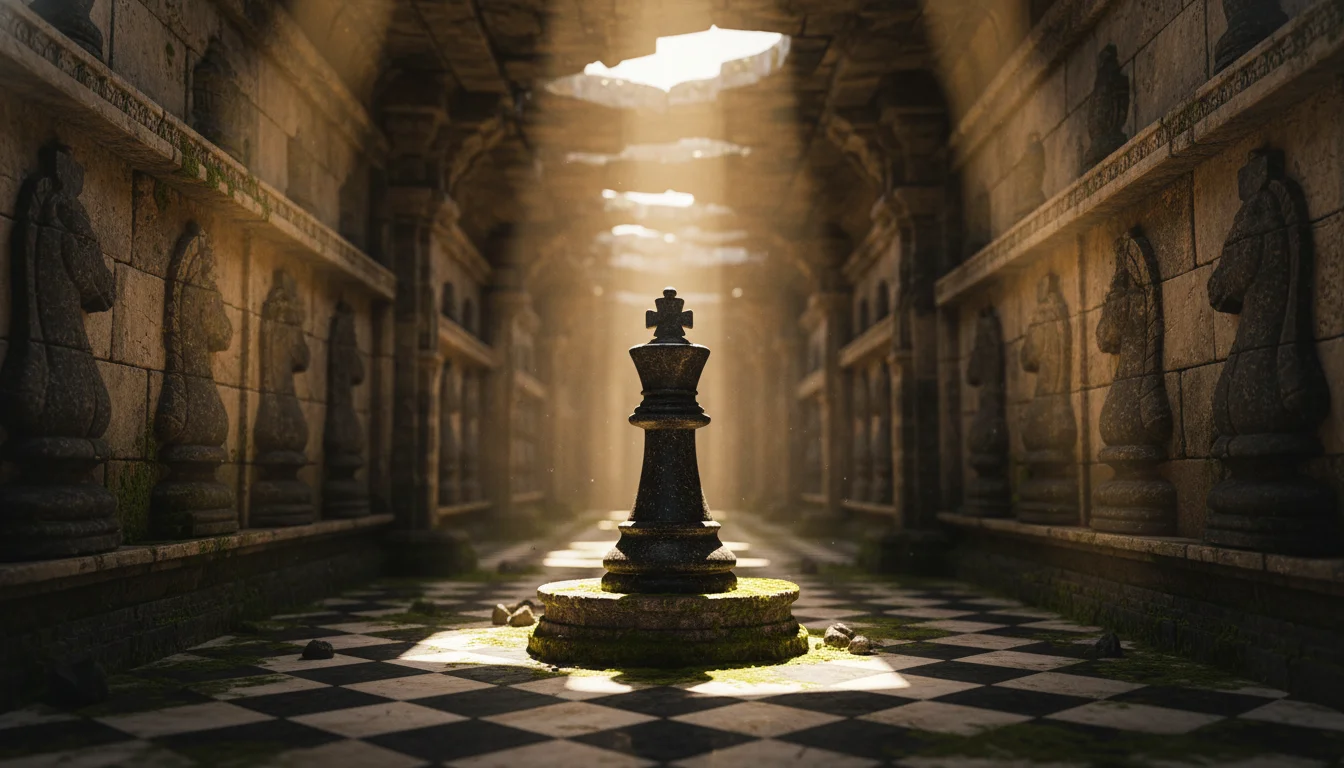
From Ancient India to a 10×10 Board: The Story of Chess and the Rise of BigChess
A game born in war, refined by scholars, reinvented by rebels, and now expanded by a piece unlike anything seen before — the Clone.
Prologue: A Game That Never Stopped Moving
Chess has always moved. Not just the pieces on the board, but the game itself — shifting shapes, absorbing cultures, shedding old rules, gaining new ones. Every time historians declare it complete, it reinvents itself. Every time a generation thinks they have solved it, someone arrives with a different board.
The version you learned to play as a child is not the version played in medieval Persia. The game Kasparov mastered is not the game a Mughal emperor played over tea. And the chess being played right now on 10×10 boards, with the Clone prowling diagonals and leaping over whole formations, is not the chess of the 20th century either.
This is the story of that movement — from the dusty courts of Gupta India to the neon glow of a screen, from the rook that was once a war chariot to the Clone that is something the game has never seen before.
Part I: Chaturanga — The First Shape of the Game (6th Century, India)
The earliest documented ancestor of chess emerged in India during the reign of the Gupta Empire, sometime around the 6th century CE. The game was called Chaturanga — Sanskrit for "four divisions of the military."
Those four divisions were the infantry, cavalry, war elephants, and chariots — the same four arms of an ancient Indian army. And those four divisions became the four foundational pieces of every chess game ever played since: the pawn (infantry), the knight (cavalry), the bishop (war elephant), and the rook (chariot).
Chaturanga was played on an 8×8 grid called an ashtāpada — a board already used for other games. There were two or four players, dice were sometimes used to determine which piece could move, and the king piece — already present — could be captured to end the game.
What made Chaturanga remarkable was not any specific rule. It was the idea: a simulation of war reduced to pure logic. No luck of terrain, no weather, no supply lines — just minds, pieces, and consequences. That idea proved indestructible.
"In no game has the genius of man expressed itself in a more concentrated form than in chess."
— Stefan Zweig
Part II: Shatranj — Persia Inherits the Crown (7th–9th Century)
When the Sassanid Persian Empire encountered chess through trade routes and diplomacy with India, the game transformed. The Persians called it Chatrang, later Shatranj, and they became perhaps its earliest serious obsessives.
Persian manuscripts documented strategy. Persian poets used chess as metaphor. The Persian court debated piece values the way modern grandmasters debate opening theory. The game was no longer merely entertaining — it was intellectual currency.
With Persian adoption came the first lasting vocabulary of chess. The Shah (king) gave us check. Shah mat — "the king is helpless" — became checkmate. The rukh (chariot) became the rook. Even the word chess traces back, via Arabic and French, to the Persian chatrang.
When the Islamic Caliphate swept across Persia in the 7th century, it inherited Shatranj too. Arab scholars wrote systematic treatises on chess strategy. They developed notation to record games. They ranked players into skill tiers. For centuries, the strongest chess players in the world came from Baghdad, Damascus, and the great cities of the Abbasid Empire.
Arab traders and conquerors carried the game westward into Spain and Sicily, northward into Central Asia and eventually to Russia, and eastward as far as China and Southeast Asia. By the 10th century, chess was the most globally distributed game on Earth — and it was still just beginning.
Part III: Medieval Europe — The Game Changes Its Face (10th–15th Century)
When chess arrived in medieval Europe through Moorish Spain and Norman Sicily, it entered a different world with different values. The military metaphors of ancient India didn't map neatly onto the feudal order of European kingdoms. So Europe did what it always does: it rewrote the game in its own image.
The war elephant, alien to European experience, became a bishop — the church official who diagonally crosses between secular and sacred worlds, moving at odd angles, never in straight lines. The chariot became a castle, the rook we know today. The counselor became a queen.
And with the queen came the most dramatic single transformation in chess history.
The Queen Revolution
In Shatranj, the piece we now call the queen was the firz or vizier — the king's chief advisor. It moved exactly one square diagonally. A short-range piece, limited and careful, like a cautious prime minister who never strays far from the throne.
Sometime around 1475 — probably in Spain or Southern France — someone gave the queen the move she has today. Any number of squares in any direction. In a single rule change, a minor court advisor became the most powerful piece on the board. The game that followed was completely different. Attacks that once took twenty moves now took five. Gambits became viable. The opening of the game cracked open like a window.
Chess historians call this the "Mad Queen" revolution, after the Italian term alla rabiosa used to describe the newly violent piece. It was the first great evidence that chess could transform itself without losing its soul.
The same era brought two more rules we still use: en passant — the strange diagonal capture that compensates for the pawn's new two-square first move — and castling, the only move in chess where two pieces move simultaneously, born from the practical need to get the king to safety faster in a game now dominated by the rampaging queen.
Part IV: The Age of Masters — Enlightenment Chess (16th–19th Century)
By the 17th century, chess was played in coffeehouses across Europe. The Café de la Régence in Paris became a legendary gathering place where philosophers, revolutionaries, and chess masters mingled. Voltaire played there. Rousseau played there. Benjamin Franklin described chess as "the game of games." Napoleon Bonaparte was an enthusiastic, if mediocre, player.
The first printed chess manuals appeared — Ruy López de Segura's 1561 treatise, Gioachino Greco's collection of games in the early 1600s — and with them came named openings. Players no longer improvised from move one. They had systems, weapons, repertoires.
In 1851, London hosted the first major international chess tournament. The winner was Adolf Anderssen, a German schoolteacher who played with the swashbuckling brilliance of the Romantic era — games full of sacrificed queens and cavalry charges that delighted spectators who couldn't follow the logic but felt the drama.
Thirty-five years later, in 1886, the first official World Chess Championship was held. Wilhelm Steinitz defeated Johannes Zukertort and became the first recognized World Champion. Chess now had a throne, and a century of battles to occupy it.
Steinitz himself had begun to transform the game's philosophy. Where the Romantic masters attacked constantly, Steinitz taught positional chess — the idea that strong players should accumulate small advantages, control space, build structures, and only attack when the position demanded it. Chess was becoming science.
Part V: The 20th Century — Grandmasters, FIDE, and the Soviet Machine
In 1924, the Fédération Internationale des Échecs (FIDE) was founded in Paris, establishing international standards, rules, and eventually the Elo rating system — a mathematical formula to quantify a player's strength that would later escape chess entirely and find its way into sports rankings, video games, and dating apps.
The 20th century produced the great champions: Lasker, Capablanca, Alekhine, Botvinnik, Fischer, Karpov, Kasparov — names that became synonymous with a particular style of mastery. The Soviet Union turned chess into a state project, training grandmasters the way other countries trained Olympic athletes. For decades, the world championship was essentially a Soviet internal competition.
Then Bobby Fischer arrived.
Fischer was American, brilliant, erratic, and impossible to ignore. His 1972 World Championship match against Boris Spassky in Reykjavik became a Cold War drama broadcast to millions. Fischer won. For a moment, it felt like chess had gone electric.
But Fischer grew disillusioned. By the 1990s, he had largely withdrawn from competitive play, and when he did speak, he said something that resonated: "Chess is played out. There is no originality left."
He meant that opening preparation had consumed the game. Grandmasters memorized hundreds of positions. The first twenty moves of a game could be a recitation, not a contest. The real chess happened, if it happened at all, in the middlegame — after the curtain of memorization finally lifted.
Part VI: The Computer Age — When the Machine Learned to Win (1990s–2000s)
In 1997, IBM's Deep Blue defeated Garry Kasparov — then considered the strongest player in chess history — in a regulation match. The world watched and didn't quite know what to feel. A machine had surpassed human mastery in the game that had defined human intellectual achievement for fifteen centuries.
The aftermath was complicated. Chess didn't die. Popularity, if anything, increased. But the game's relationship with computers changed permanently. Engines became training tools, then arbiters of truth in analysis, then eventually far beyond human comprehension entirely. Today's best chess engines see ten to twenty moves ahead with perfect efficiency. No human can compete without help.
What this meant for professional chess was uncomfortable. Opening preparation became an arms race fought with computers. Games at the highest level began in novelties buried in move 20 or 25 of an established variation. The phrase "it's all been prepared" haunted post-game press conferences.
Fischer's old complaint came back louder. Was the game of chess, in its classical 8×8 form with its inherited rules, beginning to approach exhaustion?
Part VII: The Reformers — Searching for New Chess
The response to chess stagnation took several forms, and all of them pointed in the same direction: the game needed room to breathe.
Chess960 — Fischer's Answer to His Own Problem
In 1996, Fischer proposed what became known as Chess960 (or Fischer Random Chess): a variant in which the pieces on the back rank are randomly shuffled at the start of each game, subject only to a few constraints. This generates 960 possible starting positions, obliterating the memorized opening sequences that had ossified the game.
For decades, Chess960 was a curiosity played by enthusiasts. Then, in 2024, the Freestyle Chess GOAT Challenge — a major Classical-time-control tournament played under Chess960 rules — drew the world's elite players. Magnus Carlsen won it. The Freestyle Chess Grand Slam Tour followed in 2025. A major format had found its moment.
Chess960 proved that the board's dimensions weren't the problem — what needed changing was the starting position. But it also revealed something else: even with randomized setups, the game still occupied the same 8×8 space, moved the same pieces, operated within the same ultimate horizon.
Large-Board Variants — The Question of Space
Throughout the history of chess, inventors and theorists periodically asked the other question: what if the board were bigger?
Medieval variants like Tamerlane Chess played on 10×11 boards with additional pieces. Grand Chess, designed by Christian Freeling in 1984, used a 10×10 board and introduced the Archbishop (Bishop + Knight) and Chancellor (Rook + Knight) as standard pieces. These games attracted dedicated followings among variant enthusiasts and chess theorists, but none achieved mainstream adoption.
The reason was partly practical: a larger board requires longer games, different clocks, different furniture. But it was also psychological. Players invest years learning opening theory on the 8×8 board. Any game that resets that investment faces enormous inertia.
What none of these experiments fully solved was the question of accessibility: a game that genuinely expands chess rather than replacing it, that keeps the soul of the original while giving it more room to express itself.
Part VIII: The Archbishop — A Piece Waiting for Its Moment
Before we talk about the Clone, we need to talk about the piece that became the Clone. Because this particular combination of bishop and knight moves has been haunting chess theory for four centuries.
The Archbishop — also called Cardinal, Princess, Centaur, or in some traditions simply the Bishop-Knight compound — first appeared in Turkish Great Chess, a medieval variant played on a large board where it was called the vizir. In 1617, Pietro Carrera included a similar piece in his variant Carrera's Chess, naming it the Centaur. Jose Raul Capablanca, the Cuban World Champion and one of the greatest natural talents the game has ever seen, incorporated it into Capablanca Chess in 1920 on a 10×8 board, where he gave it the name Archbishop.
The piece combines two fundamentally different movement types:
- The Bishop's move: sliding any number of squares diagonally, a long-range sweep across the board's color complex.
- The Knight's move: the L-shaped jump that ignores all pieces in between — the only piece in classical chess that leaps over obstacles.
Together, these two movements create something remarkable. The Archbishop covers both colors of the board — unlike the bishop, it is not trapped on a single diagonal complex. It can attack from a distance with the bishop's range, then close in with the knight's jump. It can sit behind a wall of pieces and leap forward to threaten a king that thought itself safe.
Theorists who study fairy chess pieces consistently rate the Archbishop at approximately 8 pawns in value — nearly as powerful as the queen (9 pawns), and notably capable of delivering checkmate entirely on its own against a bare king. That last ability — solo checkmate — is shared only with the queen and the amazon among well-known pieces. The rook cannot do it alone. The bishop cannot do it alone. The Archbishop can.
And yet for four centuries, this extraordinary piece remained on the margins — a theorist's dream, a variant enthusiast's favorite, something that never found a permanent home in a widely played game.
Until now.
Part IX: BigChess — The Board Grows Up
BigChess is played on a 10×10 board. That single fact carries more consequence than it might first appear.
One hundred squares instead of sixty-four. Files from a through j, ranks from 1 through 10. Each player begins with 10 pawns instead of 8. The back rank expands to accommodate new architecture. The game breathes differently from the very first move.
The starting position is:
10  r n a b q k b a n r
9   p p p p p p p p p p
8   . . . . . . . . . .
7   . . . . . . . . . .
6   . . . . . . . . . .
5   . . . . . . . . . .
4   . . . . . . . . . .
3   . . . . . . . . . .
2   P P P P P P P P P P
1   R N A B Q K B A N R
    a b c d e f g h i j
The king occupies the f-file. Rooks anchor the corners on a1 and j1. Knights stand beside them. And there, on the c and h squares — between the knights and the bishops — sit the Clone pieces, designated A for white and a for black in FEN notation.
Two Clone pieces per side. Four Clones on the starting board. The Archbishop has finally found its home.
Part X: The Clone — Strategy Transformed
The Clone piece in BigChess is the Archbishop with a new name and a clearly defined role. Its movement combines the Bishop and the Knight without restriction:
- It slides any number of squares diagonally, like a bishop.
- It jumps in an L-shape — two squares in one direction, one perpendicular — like a knight, leaping over any pieces that stand in its path.
Having two Clones per side — rather than Capablanca's single Archbishop per side — makes their presence felt from the opening. The game cannot be played as if they don't exist. They cannot be ignored the way a minor piece can sometimes be neutralized in classical chess. They demand a different kind of attention.
For the experienced chess player, the Clone introduces a category of threat that classical chess simply doesn't have: a long-range piece that can jump. A bishop creates lines of pressure along diagonals. A knight creates explosive, short-range jumps. A Clone does both, simultaneously, from anywhere on the board it can reach.
Consider what this means for king safety. In classical chess, a castled king behind three pawns is reasonably secure against bishop threats — the diagonals can be blocked. It is less secure against knights but a knight cannot threaten from far away. A Clone can sit on the opposite side of the board, threatening a diagonal that runs toward the king, and at the right moment execute a knight jump into a mating net that arrives from nowhere. The experience of playing against a Clone for the first time is genuinely new.
How the Clone Changes Opening Theory
In classical chess, the opening objectives are well-established: control the center, develop pieces, castle to safety. BigChess shares these objectives, but the Clone adds another: the Clone structure. Do you advance your Clones early to activate their diagonals? Do you use them defensively, exploiting their knight jumps to protect key squares? Do you exchange them for bishops, removing their color-switching ability?
The 10×10 board adds physical space that makes the opening less violent and more strategic. There is more room to maneuver before contact. Lines of attack take longer to open. The extra pawns create denser pawn structures that reward positional understanding. But the Clones cut through that space with diagonal threats that can materialize faster than most defenders expect.
Pawn Mechanics — The Triple Step
BigChess also brings a meaningful adjustment to pawn movement. Pawns on their starting rank can move two or three squares forward — an option that makes no sense on an 8×8 board where the starting rank is one step from the middle, but fits naturally on a 10×10 board where the starting rank is far from the center. Extended en passant rules follow: a pawn that leaps three squares leaves behind two possible en passant capture squares, both available to the opponent.
This single rule change — the triple step — shifts opening play significantly. Players can establish central pawns faster, trading space for tempo in ways that weren't possible before. The pawn structures that result are richer and less predictable than in classical chess.
Castling — Three Steps Instead of Two
On the larger board, the king starts on f1 rather than e1. Castling sends the king three squares toward the rook rather than two — landing on the i-file for kingside castling, the c-file for queenside. The geometry of the game requires this adjustment, and it creates slightly different post-castling positions where the king sits one square further along the back rank than experienced chess players expect.
A small change. A different feel. Exactly the kind of adjustment that rewards the player who has studied BigChess specifically rather than importing assumptions from classical chess wholesale.
Promotion — The Clone Returns
When a pawn reaches the opponent's back rank in BigChess, it can promote to a Queen, Rook, Clone, Knight, or Bishop. The Clone is a promotion option — meaning that in the endgame, the threat of promoting to a Clone rather than a queen becomes a genuine tactical weapon. A promotion to Clone threatens both diagonal control and knight jumps simultaneously. Against a player expecting only queen threats, it can be decisive.
Part XI: What BigChess Is Not
It is worth being precise about what BigChess does and does not claim to be.
It is not a replacement for classical chess. Classical chess is fifteen hundred years old, carries an unmatched competitive heritage, and will be played for centuries more. The games of Tal, Fischer, and Kasparov will remain masterpieces regardless of what happens on 10×10 boards.
It is not a gimmick, a novelty, or a simplification. The 10×10 board adds depth, not decoration. Every rule change — the Clone's movement, the triple pawn step, the extended en passant — creates new strategic complexity that rewards study. BigChess is harder to master than classical chess, not easier.
It is not a broken variant that experts can quickly solve. The addition of the Clone, the expanded board, and the modified pawn mechanics together create a combinatorial space that current chess engines — trained and optimized for 8×8 play — struggle to evaluate accurately. The opening theory of BigChess is genuinely new territory.
What BigChess is: a natural next step in the evolution of a game that has always evolved. Not the final step — there may never be one — but a considered, coherent expansion that gives chess room to grow without abandoning the principles that made it the world's most enduring strategy game.
Part XII: The Tradition of Expansion
Looking at chess history with honesty, the surprise is not that BigChess exists. The surprise is that it took this long.
The game changed dramatically between the 8th and 15th centuries. Rules that seem ancient to us — the powerful queen, pawn promotion, en passant, castling — were all innovations at some point, resisted by traditionalists, adopted because they made the game better. Every generation that received a "completed" chess game eventually passed on a modified one.
The Archbishop/Clone piece has circulated among chess theorists and variant designers since at least the early 1600s. Grand Chess and Capablanca Chess proved that a 10×10 board with this piece makes structural sense. Four centuries of experimentation converged on the same answer. BigChess assembles that answer into an accessible, playable game designed for the way people actually play today — online, on mobile, with real-time matchmaking and rating systems.
The game Capablanca sketched a century ago on 10×8 paper. The Archbishop Ralph Betza and Christian Freeling analyzed in theoretical frameworks. The expanded pawn mechanics that naturally fit a larger board. The multiplayer infrastructure that Nakama and modern game development make possible. These threads meet in BigChess.
Part XIII: The Chess Hierarchy of the Board
One of the most elegant aspects of BigChess is how cleanly its pieces form a complete hierarchy of power. Each piece occupies a distinct tier:
- Pawn — the foot soldier, now with three speeds and the potential to become anything
- Knight — the jumper, unchanged, still confusing opponents who underestimate its reach
- Bishop — the long diagonal, color-bound, a specialist
- Rook — the tower, powerful in open files, essential in endgames
- Clone — the hybrid, transcending the color limitation of the bishop, capable of solo checkmate, the breakout piece of BigChess
- Queen — the supreme force, still the most powerful single piece on the board
- King — the irreplaceable, the piece that ends games, now with more squares to protect
The Clone slots into this hierarchy between the rook and the queen — a major piece with tactical possibilities that neither the rook nor the bishop alone can match. Its value sits near 8 pawns. Its presence forces constant recalculation. Its absence from a player's game plan is felt immediately.
Part XIV: The Living Game
In the early 2020s, as online chess surged to its largest audience in history — driven by pandemic isolation, streaming culture, and the mainstream success of shows like The Queen's Gambit — a new generation encountered chess for the first time. They learned openings from YouTube, played blitz games on phones, watched grandmasters stream their training sessions.
This generation is less attached to the specific shape of classical chess than any before it. They play Chess960 as readily as standard chess. They explore variants. They have no deep investment in the particular back-rank arrangement that happened to survive from medieval Spain. They want the best version of the game.
BigChess is built for them — and for every chess player who has ever looked at the board after a long opening and thought: there should be more room here. There should be something new.
The Clone delivers that something. Not as spectacle, not as novelty, but as a piece that genuinely changes how you have to think. A piece that forces both players to reason about combinations that don't exist in classical chess. A piece that has been waiting, in various forms under various names, since the 17th century.
It has finally arrived. The game is bigger. The board is wider. And the story of chess — which began on a dusty 8×8 grid in 6th-century India — continues.
Epilogue: A Lineage
Every era of chess looked back at what came before and forward to what could come next. The Arab scholars who documented Shatranj were building on Indian Chaturanga. The European players who powered up the queen were building on Arab Shatranj. Steinitz was building on the Romantic masters. Fischer was reacting to the computer age. Capablanca, a century ago, drew diagrams of a 10×10 board and a piece that combined bishop and knight, and wrote: this is where the game should go.
BigChess is where the game goes.
The board is 10×10. There are four Clone pieces from the very first move. The pawns can run three steps. The king castles three squares. And somewhere in the middle of a game that no computer has fully mapped, that no grandmaster has fully memorized, that no tradition has fully claimed — something genuinely new is waiting to happen.
Play the game. Find out what it is.
Play BigChess now at bigchessgame.com — available on iOS, Android, and web browser.
About the Author
Vilen Fatalov
Creator of Big Chess
Ukrainian entrepreneur and chess enthusiast with over 40 years of chess experience and a Candidate Master of Sport title. Creator of Big Chess.