
Chess in the Classroom: How Strategy Games Build Smarter Thinkers

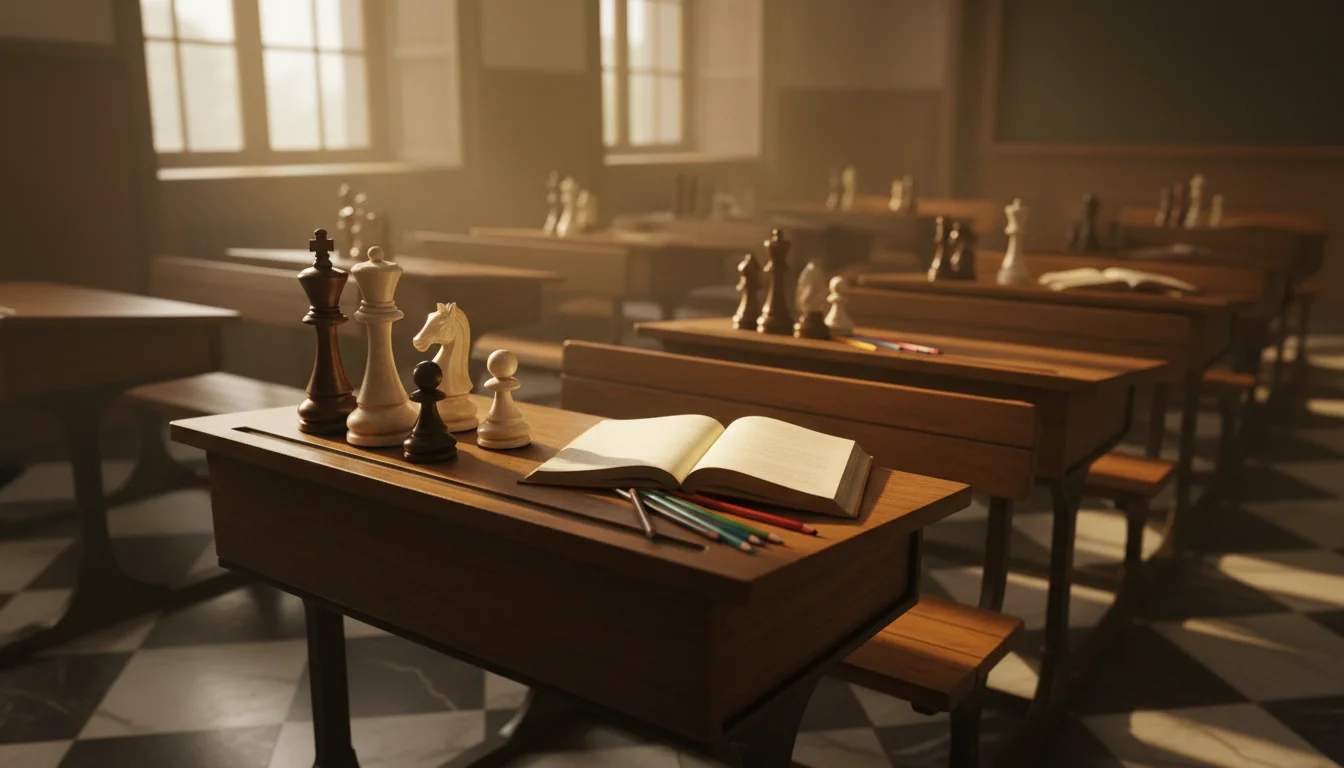
Chess in the Classroom: How Strategy Games Build Smarter Thinkers
Published on bigchessgame.com — Chess Culture & Education
In 2011, the government of Armenia made a decision that astonished educators around the world: chess would become a mandatory subject in every primary school, taught to children from the age of six. Armenia became the first country in history to require chess as a compulsory academic course — not an elective, not an after-school club, but a graded subject alongside mathematics, language arts, and science. The rationale was simple and, to those who have studied the research, entirely defensible: chess is not just a game. It is a cognitive training system of extraordinary efficiency, and the evidence for its educational benefits is both broad and deep.
Since Armenia's landmark decision, the movement to bring chess into classrooms worldwide has accelerated. In the United States, organizations like America's Foundation for Chess and Chess in Schools have placed programs in thousands of schools across dozens of states. In the United Kingdom, the Chess in Schools and Communities charity has worked with over 500,000 children. In India — a nation that produced World Champion Viswanathan Anand and a generation of grandmasters — chess programs have expanded rapidly in state schools. In the European Union, the European Parliament passed a resolution in 2012 supporting chess in education, citing its benefits for cognitive development, social inclusion, and the cultivation of values such as patience, fair play, and logical thinking.
This article explores the research and reasoning behind the chess-in-education movement, examines the specific cognitive skills chess develops, and then considers how BigChess — the innovative 10×10 chess variant available at bigchessgame.com — represents a compelling evolution of the educational chess experience, one that may offer even greater cognitive benefits for students precisely because it demands creative thinking from the very first move.
The Research Case for Chess in Schools
Academic Performance and Mathematics
The most frequently cited study in the chess-education literature is the New Brunswick (Canada) experiment of the 1990s, conducted by Dr. Adriaan de Groot's research protocols and popularized by educator Fernand Gobet. In this study, students who received 32 weeks of chess instruction demonstrated significantly higher gains in mathematics scores compared to control groups. The effect was particularly pronounced for students who had been performing below grade level — suggesting that chess reaches and engages students who are not otherwise motivated by conventional academic approaches.
A more recent study published in the Journal of School Psychology followed students in Texas schools with chess programs and found measurable improvements in both mathematics and reading comprehension. The mechanism proposed was straightforward: chess requires students to apply mathematical reasoning — spatial relationships, numerical calculation, pattern recognition — in a context that feels like play rather than instruction. Students who are reluctant to do arithmetic worksheets will spend hours calculating chess combinations.
In Belgium, a controlled experiment in the 1970s found that students given chess instruction rather than additional mathematics classes scored higher on mathematics tests at the end of the year. The finding was counterintuitive and powerful: playing chess improved mathematical ability more than doing additional mathematics homework. The explanation lies in transfer of learning — the abstract reasoning skills developed through chess practice transfer to mathematical problem-solving in ways that drill-and-practice mathematics does not always achieve.
Reading Comprehension and Language Skills
The connection between chess and reading comprehension may seem less obvious than the mathematics link, but the research supports it consistently. A landmark study conducted in Venezuela in the 1980s — part of a government program to improve national intelligence — found that chess instruction produced measurable gains in verbal intelligence and reading ability, not just mathematical reasoning. The proposed mechanism involves the visualization and narrative comprehension skills that chess demands: reading a position, understanding cause-and-effect relationships between moves, and constructing a coherent "story" of how the game will unfold are all processes that engage the same cognitive capacities as reading comprehension.
The chess student must constantly ask: "What does my opponent's last move mean? What are they planning? What is the story of this position?" This inferential thinking — reading between the lines of the position — is precisely what reading comprehension requires of students engaging with complex texts.
Critical Thinking and Executive Function
Perhaps the most important cognitive domain that chess develops is executive function — the cluster of mental skills that includes working memory, cognitive flexibility, and inhibitory control. Executive function is the mental management system that allows us to plan, focus attention, remember and use information, and manage multiple tasks. Research in developmental psychology has consistently shown that executive function is a stronger predictor of academic and life outcomes than IQ scores alone.
Chess systematically trains each component of executive function:
- Working memory is trained by holding multiple variations in mind simultaneously — "if I move here, then he goes there, then I respond with..." This mental tree of possibilities must be held in working memory and evaluated without moving the pieces.
- Cognitive flexibility is developed by the requirement to switch between attacking and defensive thinking, to evaluate the position from both players' perspectives, and to revise a plan when the opponent produces an unexpected response.
- Inhibitory control — the ability to suppress an impulsive response in favor of a considered one — is perhaps chess's most directly trained skill. The impulse to grab a pawn or make an aggressive-looking move must be controlled and evaluated before action. The chess player learns, through thousands of games, to pause before acting.
Social and Emotional Learning
Beyond pure cognitive benefits, chess programs in schools consistently show improvements in social and emotional learning outcomes. The game requires players to manage frustration — losing a piece through a mistake, being outplayed in a position they thought they controlled — and to continue competing despite adversity. It requires respect for the opponent, recognition of their skillful play, and the ability to distinguish between competitive drive (wanting to win) and poor sportsmanship (being a bad loser).
Chess also provides a powerful experience of agency — the recognition that your decisions directly determine the outcome of the game. Unlike many areas of children's academic experience, where success seems dependent on mysterious factors (talent, teacher preference, innate ability), chess provides immediate, unambiguous feedback: your decision was good or bad, and the game shows you exactly why. This cultivates what psychologists call an "internal locus of control" — the belief that outcomes depend on one's own choices and effort.
"Chess is a game that stimulates complex thinking in a simple framework. It teaches that choices have consequences." — Garry Kasparov, speaking on chess education programs
The Specific Cognitive Skills Chess Builds
Forward Planning and Consequence Analysis
At its core, chess is a consequence analysis engine. Every move creates a new set of possibilities and eliminates others. The chess player must evaluate not just the immediate effect of a move but its downstream consequences — what options it opens for the opponent, what weaknesses it creates in one's own position, and whether those consequences play out favorably over a five-move, ten-move, or twenty-move horizon.
This form of thinking — identifying consequences that extend multiple steps into the future — is precisely what is required in mathematical reasoning, scientific hypothesis testing, and strategic business planning. The student who has spent hundreds of hours calculating chess variations has built a mental habit of consequence analysis that transfers directly to these domains.
The chess concept of "prophylaxis" — making a move that prevents the opponent's best plan rather than advancing one's own plan immediately — is a sophisticated form of consequence analysis that involves modeling the opponent's intentions and preemptively addressing them. Students who learn prophylactic thinking in chess develop the perspective-taking skills that are fundamental to effective communication, negotiation, and leadership.
Sustained Concentration
In an era of smartphones, social media, and constant digital distraction, the ability to sustain focused attention for extended periods has become both more rare and more valuable. Chess demands sustained concentration over periods that range from minutes (in blitz games) to hours (in classical tournament play). A student who plays chess regularly builds the capacity to focus intensely for extended periods — a skill that is directly transferable to studying, research, writing, and any form of deep work.
The chess player who loses concentration for a single move can lose the game in an instant, even after 40 moves of brilliant play. This unforgiving relationship between attention and outcome teaches students — experientially, not theoretically — that sustained concentration matters. No teacher can convey this lesson as effectively as a game that immediately punishes lapses of attention.
Abstract Reasoning and Pattern Recognition
Chess is an exercise in abstract reasoning: the pieces are not real soldiers, the board is not a real battlefield, and the rules are arbitrary conventions that define a purely abstract space. Yet within this abstract space, patterns emerge — tactical motifs, positional structures, endgame geometries — that must be recognized, categorized, and applied. This process of abstract pattern recognition is foundational to mathematical reasoning, scientific classification, and logical argumentation.
Research by cognitive psychologist Fernand Gobet on chess expertise has shown that the difference between novice and expert chess players lies primarily in the number of "chunks" — meaningful patterns — stored in long-term memory. An expert grandmaster has internalized tens of thousands of chess patterns, allowing them to rapidly assess a position by recognizing which stored patterns it resembles. This chunking process is exactly how expertise is built in any complex domain — medical diagnosis, legal analysis, software engineering — and chess provides an extraordinarily efficient way to develop the underlying cognitive machinery.
Decision-Making Under Uncertainty
Chess presents the player with an information-complete game — both players can see the entire board at all times. Yet chess is still a game of profound uncertainty, because the number of possible positions is larger than the number of atoms in the observable universe. The chess player must make decisions based on an incomplete calculation of all possible outcomes, relying on judgment, intuition built from pattern recognition, and principled evaluation of complex positions.
This is precisely the situation that decision-makers face in real life: complete information is rarely available, time is limited, and choices must be made despite uncertainty. The student who has learned to make good chess decisions under these conditions has developed a transferable decision-making methodology that will serve them throughout their lives.
The OpenBigChess Educational Advantage: Learning Without Memorization
Classical chess presents a problem for educational programs that is rarely discussed openly: the game has been played for over 500 years, and the accumulated body of opening theory — the catalogued sequences of moves that define how high-level games begin — is vast beyond any individual's ability to fully absorb. A student entering the competitive chess world today faces opponents who have memorized dozens of opening variations to depths of 20 or 25 moves. For a student who encounters chess in a school program, this situation can be deeply discouraging: you work hard to understand the game, and then discover that an opponent with more memorization time has an automatic advantage before any creative thinking occurs.
This is where BigChess — designed by Ukrainian chess entrepreneur and Candidate Master of Sport Vilen Fatalov, who brings over 40 years of chess experience to the game's design — offers a profound educational advantage. BigChess is played on a 10×10 board with 100 squares, features two new Clone pieces per side (each combining the bishop's diagonal slide with the knight's L-shaped leap), and introduces a triple pawn step option from the starting rank. The game is sufficiently different from classical chess that there is no accumulated opening theory to memorize.
Every student who approaches BigChess for the first time is genuinely equal to every other student who approaches it for the first time. There is no advantage from years of opening preparation. There is no disadvantage from lack of access to expensive coaching or computer analysis databases. The creative thinking that good chess education is supposed to develop — but that competitive classical chess sometimes discourages in favor of memorization — is required from move 1 in BigChess.
The Clone as an Educational Problem
The Clone piece — BigChess's most distinctive innovation — presents students with a genuinely new reasoning problem. The piece moves in two completely different ways: it can slide diagonally like a bishop, or leap in an L-shape like a knight. Understanding how to use a piece with dual movement modes requires exactly the kind of flexible, creative reasoning that chess education aims to develop.
When a student encounters the Clone for the first time, they cannot rely on memorized patterns — there are none. They must reason from first principles: "This piece moves diagonally, so it threatens these squares. And it can also jump in an L-shape, so it also threatens those squares. What double threats can I create? What squares does it control that neither a bishop nor a knight alone could control?" This is pure creative reasoning, and it is exactly what educators want chess to teach.
Moreover, the Clone's dual movement modes make it a natural entry point for discussions of combination and synthesis in reasoning — not just in chess, but in mathematics (where combining two different operations can produce results neither can achieve alone) and in science (where interdisciplinary approaches often solve problems that single-discipline approaches cannot).
BigChess Puzzles as Classroom Tools
The BigChess puzzle system available on the platform provides a structured training environment that is ideal for classroom use. BigChess puzzles range in difficulty from beginner-accessible tactical problems to advanced Clone combination exercises. Unlike classical chess puzzles — where many exercises are based on memorized tactical patterns — BigChess puzzles require genuine calculation, because the patterns themselves are new and cannot be recognized through rote memorization.
In an educational setting, this means that the student who solves a BigChess puzzle has genuinely reasoned through the solution, not matched it to a stored pattern. The cognitive benefit of puzzle solving is therefore more authentic and more deeply internalized than it would be if the student were pattern-matching to familiar positions.
Teachers can use BigChess puzzles as classroom exercises in analytical reasoning: present the position, have students write down their analysis of candidate moves and their consequences, then discuss which solution is best and why. This structured approach to puzzle solving teaches the analytical writing and argumentation skills that are directly transferable to essay writing, scientific reporting, and logical argumentation.
Global Chess Education Programs: What They Teach Us
Armenia: The World's First Chess Nation
Armenia's mandatory chess curriculum begins at age six and continues through primary school. The curriculum is specifically designed to develop cognitive skills, not to produce tournament players — though Armenia has produced a remarkable number of strong players as a byproduct of the program. The focus is on problem-solving, the cultivation of patience, and the development of the understanding that effort and analysis produce better outcomes than impulsiveness.
Armenian educational authorities report that the program has had positive effects beyond chess: teachers note improvements in students' ability to sit focused, to think before answering questions, and to handle competitive situations with equanimity. The program has been studied by educational researchers from dozens of countries.
The United States: Chess in Low-Income Schools
Some of the most compelling research on chess in education comes from programs specifically targeting underserved schools in low-income communities in the United States. The evidence from these programs — in New York City, in rural Appalachian communities, in inner-city schools across Chicago and Detroit — consistently shows that chess instruction has outsized benefits for students who face the most significant academic challenges.
The hypothesis, supported by several studies, is that chess provides these students with an experience of academic mastery that they may not otherwise receive. A student who struggles in traditional academic settings may discover that chess is a domain in which they can excel — and the experience of excelling at something intellectually demanding has profound effects on self-concept, academic motivation, and the belief that intelligence is cultivable through effort rather than fixed at birth.
India: Chess and Academic Culture
India's chess culture has produced a remarkable number of grandmasters in the past three decades, partly through school programs that introduced chess broadly and then developed exceptional talent through specialized training. The country's trajectory from producing almost no grandmasters before the 1990s to producing over 70 as of the mid-2020s illustrates what is possible when chess education is taken seriously at a national level.
Indian educational researchers have also noted that chess programs in schools with strong science and mathematics curricula produce particularly strong synergies — the abstract reasoning demands of chess and of STEM subjects reinforce each other in ways that improve performance in both domains.
BigChess in the Classroom: A Practical Vision
What would a BigChess-based classroom program look like in practice? The following is a vision based on the principles of effective chess education and BigChess's specific characteristics:
- Beginner sessions: Introduce the board, the pieces, and the basic rules. Pay special attention to the Clone's dual movement modes — this is the conceptual core of BigChess and deserves careful introduction. Use visual demonstrations of the Clone's reach (which squares it can attack from a central position) to build geometric intuition.
- Intermediate sessions: Introduce tactical motifs — forks, pins, discovered attacks. Then develop BigChess-specific motifs involving the Clone. The Clone fork (threatening two pieces simultaneously via diagonal and knight-jump attacks) is a natural first BigChess tactic to teach.
- Advanced sessions: Study pawn structure, the triple pawn step, and endgame principles. Introduce the BigChess puzzle system as a homework tool for daily tactical practice.
- Cross-curricular integration: Use BigChess positions as problem-solving exercises in mathematics class (counting controlled squares, calculating material values) and in language arts (writing analytical essays about why a particular move is best).
The ELO matchmaking system on bigchessgame.com means that students are always matched against opponents of similar strength — a feature that is pedagogically important, as students learn best when challenged at an appropriate level, not overwhelmed or underwhelmed.
Conclusion: The Classroom of the Future
Chess education has proven its value over decades of research and real-world implementation in dozens of countries. The cognitive skills it develops — forward planning, consequence analysis, sustained concentration, abstract reasoning, decision-making under uncertainty — are exactly the skills that the knowledge economy of the 21st century demands. Countries and schools that have invested in chess education have seen measurable returns in academic performance and student development.
BigChess represents an evolution of this educational tradition that is particularly well-suited to the current moment. In a world where students can access endless accumulated chess theory online — where the opening advantage of a prepared competitor can be measured in gigabytes of computer analysis — BigChess returns chess to its educational essence: pure reasoning from first principles, with no memorization shortcuts and no accumulated theory to hide behind.
The Clone piece, the triple pawn step, the 10×10 board — these are not gimmicks. They are mechanisms that ensure every student approaches the game as a learner, not as a memorizer. And in that posture of genuine learning — of reasoning through new problems without the crutch of prior knowledge — lies the deepest educational value of chess.
The classroom of the future teaches students to think. BigChess is a powerful tool for that purpose.
Bring BigChess into your classroom or learning practice. The 10×10 board, the Clone piece, and the triple pawn step create a game where creative thinking starts at move 1 — where every student learns on a genuinely level field. Play, puzzle, and practice at bigchessgame.com, available on web, iOS, and Android. The ELO system ensures you always play at the right level. The puzzle system provides daily tactical training. The game history lets you review and learn from every game you play. Start thinking — and start playing — today.
About the Author
Marat Fatalov
Co-inventor of Big Chess
High School Student, Co-inventor of Big Chess, Second Category chess player.