
Why BigChess Changes the Game

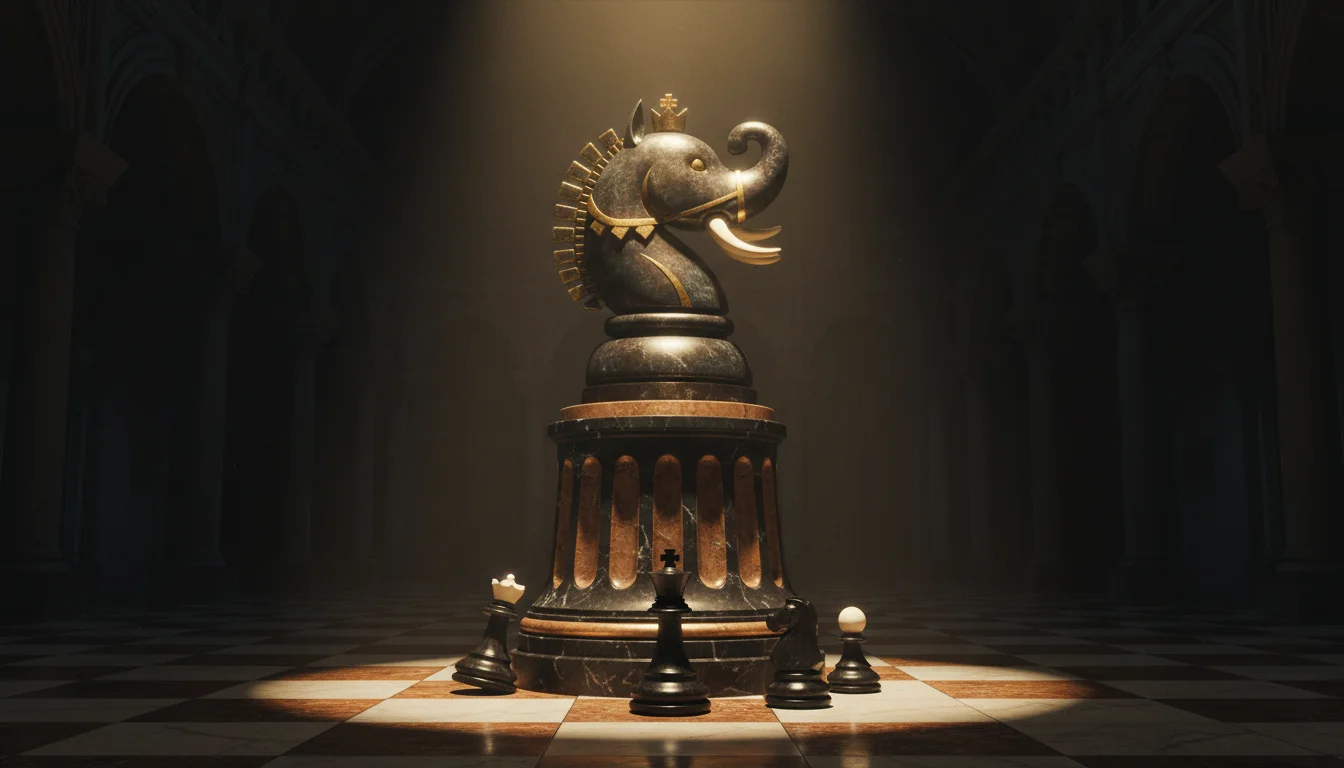
Why BigChess Changes the Game: The Case for a 10×10 Board and the Clone Piece
Chess has been played for over 1,500 years. It has survived empires, survived wars, survived the internet, survived computers that can now beat every human alive. And yet, at the highest levels, the game has been slowly calcifying under the weight of its own theory. Grandmasters arrive at the board with 30-40 moves of preparation memorized in each opening line. Draws have become an accepted outcome between the elite. The game — still beautiful, still profound — has been mapped to a degree that Morphy or Capablanca would have found unthinkable.
BigChess doesn't discard classical chess. It completes it.
A 10×10 board. A tenth pawn per side. A castling rule that gives the king a little more breathing room. And one new piece — the Clone — that quietly rewires everything you thought you knew about piece coordination, tactics, and positional play.
The Problem That Chess Champions Saw Coming
You don't have to take our word for it. José Raúl Capablanca, the third World Chess Champion and one of the most gifted natural players in history, was already worried about this in the 1920s. He proposed adding two new pieces to a larger board specifically to fight what he called the "draw death" of chess — the tendency of theory-heavy preparation to neutralize creativity and produce lifeless, agreed-upon draws at the top level.
Capablanca's proposed variant never caught on, partly because the chess establishment was conservative, and partly because no one had built the infrastructure to make a new form of chess accessible and playable. The idea was right. The timing was wrong.
A hundred years later, the tools exist. Online play, AI-powered matching, ELO rating systems, and mobile apps have made it trivially easy to play any variant against any opponent anywhere in the world. The problem of distribution is solved. What remains is the problem of design: which changes to chess actually improve it, and which just make it different?
BigChess makes choices that are deliberate, conservative where they should be conservative, and bold exactly where boldness is needed.
The 10×10 Board: Space Changes Everything
Moving from an 8×8 board to a 10×10 board is not merely an expansion. It's a phase shift.
In standard chess, the board is so compressed that pieces interact almost immediately. Opening theory exists in large part because the board is small enough that there are only so many reasonable ways to develop pieces and contest the center. The first 15–20 moves have been analyzed exhaustively, to the point where a player who deviates early is often considered to be already at a disadvantage before the real game begins.
A 10×10 board has 100 squares — 56% more space than the 64 squares of classical chess. This isn't a small adjustment. It means:
- Development takes longer. Pieces need more moves to reach active positions, which means the opening phase is genuinely exploratory rather than a recitation of memorized lines.
- The center is larger and harder to control. Controlling four central squares is already a challenge. Controlling a meaningful portion of a 10×10 center requires coordinated effort and creative piece placement.
- Endgames are more complex. With more pawns — ten per side instead of eight — pawn structure decisions carry more weight and more nuance.
- Tactical patterns exist that simply cannot appear on an 8×8 board. Longer diagonals, deeper files, more distant attacks. The geometry of the game changes in ways that create entirely new problems to solve.
For the player who has exhausted classical chess's opening theory, the 10×10 board is a fresh continent. You're exploring, not following a map.
The Clone: A Piece That Should Have Always Existed
Of all the changes BigChess makes, the Clone is the most significant. It also has the deepest theoretical roots.
The Clone — also known in chess theory as the Archbishop or Cardinal — combines the movement of a Bishop and a Knight into a single piece. It can slide any number of squares diagonally (like a Bishop), and it can jump in an L-shape (like a Knight). It cannot be blocked on its Knight moves. It covers both color complexes, unlike the Bishop. It can reach every square on the board.
Two Clones start on each side, positioned between the Knights and Bishops in the back rank:
10  r  n  a  b  q  k  b  a  n  r
 9  p  p  p  p  p  p  p  p  p  p
    a  b  c  d  e  f  g  h  i  j
The Clone occupies a position in piece value that sits clearly above a Bishop or Knight, and approaches the power of a Rook in the right positions. Its combination of range and jump ability makes it simultaneously a long-range attacker and a short-range infiltrator.
Why the Clone Works Where Other Proposals Failed
Chess theorists and inventors have proposed hundreds of new pieces over the centuries. Most are forgotten because they either don't fit the aesthetic of chess, are too powerful (breaking the balance), or solve a problem that didn't exist.
The Clone — the Bishop-Knight compound — is different for a specific reason: it is color-independent. A Bishop permanently occupies one color of squares. Two Bishops on opposite colors still have blind spots along the edges. The Clone sweeps diagonally like a Bishop but can jump to any color, which means it doesn't inherit the Bishop's fundamental limitation. This makes it feel natural on the board — it fills a gap in the piece family that, once you understand it, seems obvious.
On a 10×10 board, where longer diagonals exist and more space separates pieces in the opening, the Clone's range becomes genuinely relevant from early in the game. It can threaten from distance, shift color complexes in a single move, and create forks that combine diagonal pressure with knight-jump threats. No piece in classical chess can do this.
New Tactical Patterns You've Never Seen Before
Every chess player has a mental library of tactical patterns: the back-rank mate, the knight fork, the bishop skewer, the rook battery. These patterns were discovered, named, and catalogued over centuries of play. They are so well known that recognizing them is a core part of chess skill development.
The Clone generates tactical patterns that don't exist in standard chess.
Consider: a Clone on d4 threatens diagonally to b6, c5, e5, f6, g7, h8 — but it also threatens via knight jump to b3, b5, c2, c6, e2, e6, f3, f5. That is up to fourteen squares it attacks simultaneously. In a tactical position, a Clone in the center creates threats that are genuinely difficult to calculate, because the opponent must account for both types of movement simultaneously.
The Clone pin is a new motif. The Clone fork — combining a diagonal threat with a knight jump — has no equivalent in classical chess. The Clone outpost, where a Clone sits on a square that cannot be attacked by enemy pawns and radiates threats across multiple lines, is a positional concept that experienced players will need time to fully appreciate.
This is not chaos. This is new depth, built on the same logical foundation as classical chess tactics. Players who invest in understanding the Clone will be rewarded with a richer tactical vocabulary.
Modified Rules That Respect the Game
BigChess doesn't change rules arbitrarily. The modifications to pawn movement, en passant, and castling all follow from the logic of the larger board.
Triple Pawn Step
In standard chess, pawns on their starting rank can move one or two squares. In BigChess, they can move one, two, or three squares. This addresses a real problem: on a 10×10 board, pawns starting on the second rank face a longer journey to the center. The triple step option allows faster development and more dynamic pawn play in the opening, while adding a new layer to en passant calculation.
Extended En Passant
When a pawn makes a triple step, any square it passes over becomes a valid en passant target. This means the en passant rule extends naturally to cover the new pawn movement, preserving the spirit of the rule (no free passes through a threatened file) on the larger board.
Castling: King Moves Three Squares
With the king starting on the f-file (instead of e-file), castling moves the king three squares rather than two. The king lands on the i-file for kingside castling and the c-file for queenside. This keeps king safety relevant — the king tucks away as securely as in classical chess — while respecting the geometry of the wider board.
These are not gimmicks. Each rule change is a direct, logical consequence of playing on a 10×10 board. The game remains recognizable as chess because the underlying principles — king safety, piece activity, pawn structure, control of key squares — are unchanged. What changes is the canvas on which those principles play out.
The Pilgrim: Power Meets Elegance
It's worth dwelling a moment on what the Clone offers strategically, not just tactically.
In classical chess, Bishops and Knights have a fundamental asymmetry: Bishops are long-range pieces that thrive in open positions, while Knights are short-range pieces that prefer closed positions with stable outposts. The tension between these two piece types creates much of classical chess's strategic richness — the eternal debate over Bishop versus Knight is one of the game's deepest positional themes.
The Clone participates in this dynamic in a unique way. It combines both piece types, which means it is neither strictly a long-range piece nor strictly a short-range piece. It can operate in open positions (using its diagonal range) or in closed positions (using its knight jumps to leap over pawn chains). This makes it the most positionally flexible piece in BigChess, and the hardest to neutralize.
A Rook can be blocked by a closed file. A Bishop can be hemmed in by pawns on its color. A Knight can be kept away from key squares by well-placed pawns. The Clone is resistant to all of these standard methods of piece restriction. Dealing with an active Clone requires genuine positional creativity — there is no formula.
Chess Is Good for Your Brain. BigChess Pushes That Further.
The cognitive benefits of chess are well-documented and increasingly supported by neuroscience. Research shows that chess players develop stronger planning ability, better working memory, enhanced pattern recognition, and more resilient cognitive function as they age. Brain imaging studies have found that expert chess players show greater activation in regions associated with visual-spatial processing and executive function, and stronger connectivity in networks underlying decision-making.
These benefits derive from the demands the game places on the mind: calculating variations, recognizing patterns, making decisions under time pressure, managing uncertainty. BigChess doesn't reduce these demands — it amplifies them.
The larger board means more pieces to track, more squares to evaluate, more pawn structures to understand. The Clone adds a new class of threat that experienced players must learn to see. The extended opening phase means more genuine decision points, fewer memorized sequences. A BigChess player is solving harder problems than a classical chess player, and the cognitive return reflects that.
For younger players learning the game, BigChess provides a richer environment for developing tactical and strategic thinking. For experienced players, it provides exactly what classical chess at the highest levels increasingly cannot: novelty, challenge, and the irreplaceable experience of being genuinely uncertain about the right move.
The Landscape of Chess Variants: Where BigChess Fits
Chess variants have existed almost as long as chess itself. Shatranj, the ancestor of modern chess, had its own regional variants across the medieval Islamic world. European players modified the rules during the Renaissance, producing the game we know today. Capablanca's variant in the 1920s was followed by dozens of other proposals: Fischer Random Chess (Chess960), Grand Chess by Christian Freeling, Shogi-influenced hybrids, Three-Check, Crazyhouse, and hundreds more.
Most variants fall into one of two categories: simplifications (faster games, fewer pieces, smaller boards) or eccentricities (unusual rules that create interesting edge cases but don't feel like chess). Very few additions to the chess family have expanded the game in a way that feels like a natural continuation rather than a departure.
BigChess is in this rare category. It keeps everything that makes chess chess: the pieces you know, the rules you've internalized, the strategic vocabulary you've spent years building. It adds to that foundation rather than replacing it. A classical chess player who sits down to their first BigChess game will feel oriented within minutes. The strangeness is superficial; the depth is real.
Online Play: BigChess Is Ready
One reason chess variants have historically struggled to find audiences is accessibility. You can't play Capablanca chess at your local club because nobody has the board. You can't practice Grand Chess online because the platform you use doesn't support it.
BigChess was built online-first. The game server handles real-time multiplayer matches, ELO-based matchmaking that pairs players of similar strength, full game history and PGN export, a puzzle system for tactical training, observer mode for watching and learning from others' games, and leaderboards that make progress visible and motivating.
This is infrastructure that took the classical chess ecosystem decades to build. BigChess has it from day one, because the lessons of online chess were learned before BigChess was built.
The result is that playing BigChess against a human opponent anywhere in the world, at any time, with matched skill levels and complete game records, is straightforward. There is no friction between wanting to play and actually playing. That matters more than it might seem — the history of chess variants is full of games that were good ideas but died because they were too hard to find partners for.
For Classical Chess Players: What You Gain, What You Don't Lose
If you play classical chess at any level — casual weekend games, club tournaments, online blitz — BigChess doesn't ask you to abandon what you know. The pieces move the same way. Check and checkmate work the same way. The core strategic ideas — controlling the center, activating your pieces, creating passed pawns, coordinating your major pieces — transfer directly.
What you gain is a game where your opening preparation is largely irrelevant (freeing you to think for yourself from move one), where tactical alertness is rewarded more heavily than memorization, and where the Clone introduces patterns you've never had to calculate before.
Many experienced chess players report that BigChess restores something that gradual familiarity with classical chess can dull: the feeling of genuine discovery at the board. The sensation of seeing a position you've never seen before and having to work out what's happening. That sense of exploration doesn't disappear with experience in BigChess — the Clone alone guarantees it, because Clone tactics are still being discovered.
For New Players: A Better First Experience
There's a version of the chess learning experience that is not particularly fun: learning that every opening move you make has been analyzed to a draw twenty moves deep, and that you are essentially playing a trivia game about memorized lines rather than a strategy game. This is an exaggeration, but it's not entirely wrong for competitive play at intermediate levels.
BigChess new players don't have this problem. The opening theory for a 10×10 board with a Clone piece is in its early stages. Strong engine analysis exists — BigChess uses Fairy-Stockfish, one of the strongest variant chess engines available — but the human understanding of BigChess strategy is genuinely developing. A new player learning BigChess is learning a game whose strategic landscape is being mapped in real time. They are not behind; they are part of a community figuring it out together.
This is the experience that made classical chess so compelling in the 19th century, when great players were still discovering fundamental ideas. That frontier is gone in classical chess. In BigChess, it's wide open.
The Clone in Practice: Three Scenarios
1. The Opening: Development With Dual Purpose
In the BigChess opening, the Clone is typically developed early toward the center, where its diagonal range and knight-jump reach cover the most squares. A Clone on d4 or g4 (or their mirror squares for Black) simultaneously supports pawn advances in the center, covers key squares against knight incursions, and threatens to swing to either flank. Unlike a Knight, which can be chased away by pawns, a Clone has so many escape routes and threat vectors that chasing it typically creates weaknesses for the attacker.
2. The Middlegame: The Clone Fork
The Clone's unique tactical threat is the diagonal-plus-jump fork: attacking two pieces simultaneously where one threat is via a long diagonal slide and the other is via a knight jump. The opponent must consider both vectors when defending, and often cannot cover both at once. This is a pattern that does not exist in classical chess and takes time to learn to see — both for the attacker setting it up and for the defender trying to prevent it.
3. The Endgame: Clone Versus Rook
In BigChess endgames, Clone versus Rook is a genuine theoretical question. Unlike the classical Bishop-versus-Rook or Knight-versus-Rook endgames (which are well understood), the Clone's combination of range and jump ability makes this contest rich and complex. The Clone can pressure from distance and then switch squares in ways that a Bishop or Knight cannot, while the Rook's linear power is complicated by the Clone's ability to threaten along two different movement types simultaneously. This endgame type is still being studied.
Where We Are
BigChess is not a proposal. It is not a thought experiment. It is a working, playable game with a functioning online platform, AI-powered matchmaking, engine support, and a growing community of players who have moved from classical chess and are not going back.
The game will continue to develop. New opening ideas will emerge. Clone tactics will be catalogued and named. Endgame theory will deepen. Strong players will develop the kind of deep positional understanding of the Clone that took centuries to develop for the Queen after it gained its modern powers in the 15th century.
That process has started. The players doing the discovering are playing right now.
Play BigChess
If you play chess — at any level, with any degree of seriousness — BigChess is worth your time. Not as a novelty. Not as a curiosity. As a game that is more complex, more creative, and more genuinely challenging than the classical game, built on the same foundation with thoughtful additions that expand rather than replace what makes chess great.
The board is 10×10. The Clone is waiting. Come find out what it can do.
About the Author
Vilen Fatalov
Creator of Big Chess
Ukrainian entrepreneur and chess enthusiast with over 40 years of chess experience and a Candidate Master of Sport title. Creator of Big Chess.