
The Art of Pawn Structure: Classical Principles Reimagined for BigChess's Triple Step

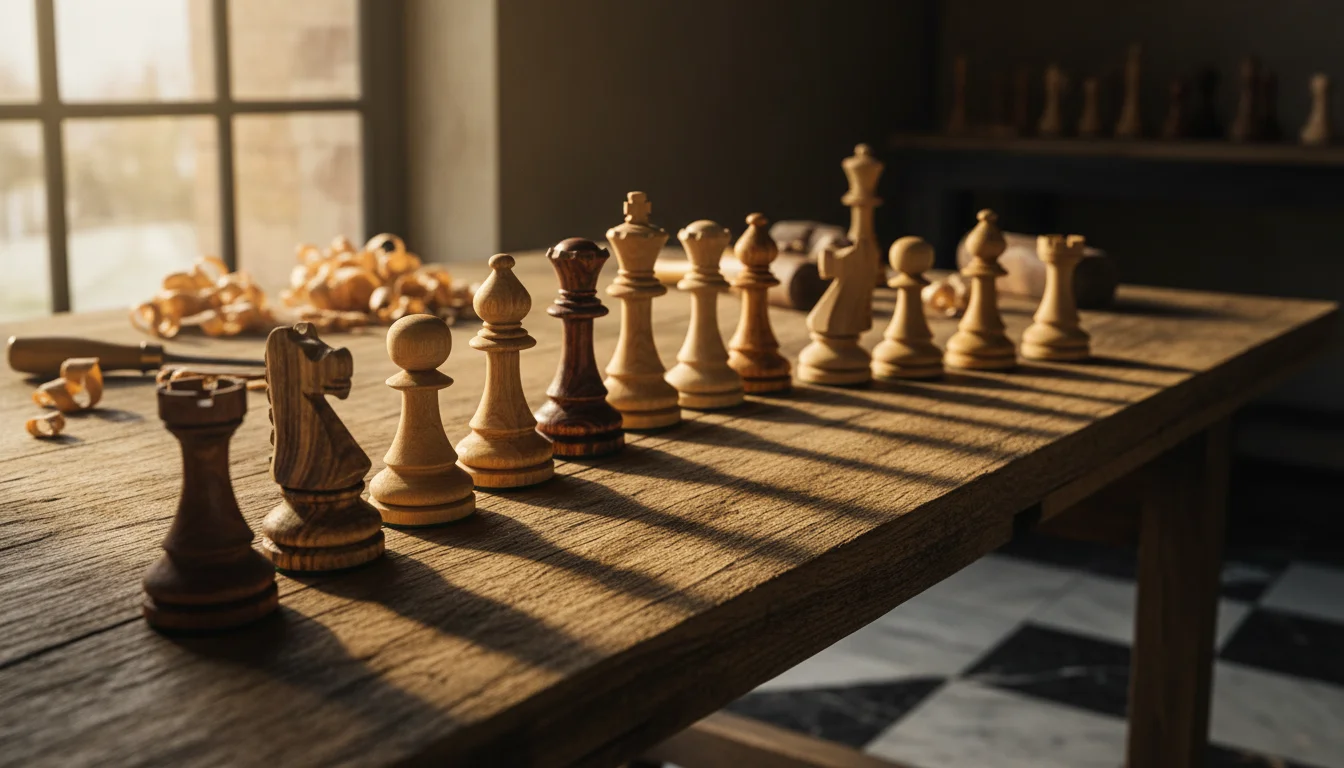
The Art of Pawn Structure: Classical Principles Reimagined for BigChess's Triple Step
Published on bigchessgame.com — Strategy & Theory
François-André Danican Philidor, the greatest chess player of the 18th century, made a statement that has echoed through chess literature for over two hundred years: "Les pions sont l'âme des Échecs" — "Pawns are the soul of chess." At the time, this was a radical idea. The conventional chess thinking of Philidor's era treated pawns as nearly expendable — as the board furniture to be moved aside while the "real" pieces conducted warfare. Philidor argued that pawns were not just minor factors but the structural foundation upon which all chess strategy is built. The position of the pawns determines the character of the position, the strengths and weaknesses of both sides, and the fundamental strategic direction of the game.
Philidor was right. Two centuries of chess development have only deepened the understanding of how profoundly pawn structure shapes everything that happens on the chess board. In the 20th century, Aron Nimzowitsch systematized this understanding in his landmark work My System, which devoted enormous analytical energy to pawn structures — to the passed pawn, the isolated pawn, the pawn chain, the doubled pawn, the backward pawn — and showed how each structural feature creates specific long-term strategic advantages and disadvantages that persist throughout the game regardless of the positions of the pieces.
The study of pawn structure is not merely academic. It is the language in which the deepest chess strategies are written. And in BigChess — the revolutionary 10×10 chess variant available at bigchessgame.com, featuring 10 pawns per side, a triple pawn step option, extended en passant, and the brand-new Clone piece — classical pawn structure theory must be not only applied but fundamentally reimagined. BigChess creates pawn structures with no classical equivalent, strategic dilemmas that Nimzowitsch never considered, and a relationship between pawn play and Clone development that is entirely new theoretical territory.
This article examines pawn structure from its classical foundations through to the specific innovations that BigChess introduces — and provides a strategic framework for pawn play in a game where the triple step changes everything from move 1.
Philidor, Nimzowitsch, and the Soul of Chess Strategy
Philidor's Revolution
Philidor's contribution to chess theory was not merely the famous statement about pawns. It was an entire playing philosophy: that the correct approach to chess was to build strong pawn structures, restrict the opponent's pawn mobility, and then exploit the resulting positional advantages through patient, systematic play. Philidor's games — which have been analyzed and admired for two centuries — embody this philosophy in practice: pawn formations used to restrict the enemy's pieces, pawn advances used to create space and attacking opportunities, and pawn structures maintained with a discipline that seemed alien to his contemporaries, who were more interested in romantic sacrificial attacks.
Philidor introduced the world to the concept that a chess position has a long-term strategic character — that the position after 30 careful moves might be inevitable given the pawn structure established after 5 moves. This idea — that the pawns determine the strategic destiny of the position — is the founding insight of modern positional chess.
Nimzowitsch and the Systematic Treatment
Aaron Nimzowitsch (1886-1935) brought Philidor's insight to its systematic culmination in My System (1925) and Chess Praxis (1929). These works provided, for the first time, a comprehensive analytical treatment of pawn structure — naming, describing, and evaluating every major structural feature that arises in practice. Nimzowitsch's analytical framework remains the foundation of how chess coaches teach positional thinking today.
"The passed pawn is a criminal who should be kept under lock and key. Mild measures, such as police surveillance, are not sufficient." — Aaron Nimzowitsch
This characteristically vivid quotation captures one of Nimzowitsch's central insights: that a passed pawn — a pawn with no enemy pawns on its file or adjacent files to prevent its advancement — is a uniquely powerful and dangerous element. A passed pawn that can advance toward promotion demands constant defensive attention. If the opponent fails to blockade it, the pawn advances; if they sacrifice a piece to blockade it, they may be materially down but structurally secure.
Classical Pawn Structures: The Essential Vocabulary
The Isolated Pawn (Isolani)
An isolated pawn is a pawn with no friendly pawns on adjacent files. It cannot be defended by other pawns and therefore represents a structural weakness: it must be defended by pieces. If the opponent can target the isolated pawn with pieces, they can force the defender to commit defensive resources to its protection — freeing the attacker's pieces for other operations.
The isolated queen's pawn (IQP) — a d-pawn isolated in the center — is the most discussed isolated pawn in classical chess. It creates a fascinating structural duality: the pawn is a weakness that can be targeted, but the open files and diagonals on either side of it give the player owning it active piece play and attacking chances. Whether the IQP is a strength or a weakness depends on the specific piece configuration and the phase of the game: in the middlegame with active pieces, it often supports a strong initiative; in the endgame with reduced material, it is typically a liability.
Doubled Pawns
Doubled pawns — two pawns of the same color on the same file — arise typically from pawn captures. They represent a structural inefficiency: two pawns that should control two adjacent files are instead stacked on one file, controlling less space and defending each other less effectively than separated pawns would. Doubled pawns are generally considered weaknesses, but their evaluation depends on compensation: open files for rooks, active piece play, or dynamic attacking possibilities may outweigh the structural concession.
The Backward Pawn
A backward pawn is a pawn that cannot advance because the squares immediately in front of it are controlled by enemy pawns, and which cannot be supported by adjacent friendly pawns because those pawns have advanced further. A backward pawn on an open file is the worst form of the weakness: it can be attacked along the file by rooks and queen, and the square in front of it — the "hole" — becomes an outpost for the opponent's pieces. Understanding backward pawns is essential to both attacking and defensive play at the intermediate and advanced levels.
The Passed Pawn
A passed pawn — a pawn that has no enemy pawns on its file or adjacent files to prevent its advance — is potentially the most powerful structural advantage in chess. A passed pawn that has advanced to the sixth rank (near promotion) ties down enormous defensive resources. The endgame principle "the passed pawn must be pushed" captures the dynamic nature of this advantage: a passed pawn that is allowed to stagnate is merely a potential threat; a passed pawn that advances becomes an existential threat that dominates the game.
The power of the passed pawn is why the endgame principle "outside passed pawn" is so important: a passed pawn on one side of the board, far from the main action, can win games by drawing the opponent's king to that side of the board while the attacking king invades on the other side.
The Pawn Chain
A pawn chain — a diagonal formation of pawns, each defending the one behind it — was Nimzowitsch's particular analytical obsession. He showed that pawn chains have specific attacking and defensive characteristics: the front of the chain (the most advanced pawn) cannot be defended by other pawns, while the base of the chain (the rearmost pawn) is the critical weakness. The correct way to attack a pawn chain is at its base; the correct way to defend it is to protect the base and advance the chain to create new attacking possibilities.
Classical pawn chain structures — the French Defense pawn chains, the King's Indian Defense formations, the Ruy Lopez pawn structures — have been analyzed exhaustively. Every classical opening creates a specific pawn structure, and understanding what that structure means for the long-term strategy is the first task of positional chess education.
Pawn Islands
The concept of pawn islands — isolated groups of connected pawns — was developed by the great teacher Siegbert Tarrasch. A player with fewer pawn islands has a structurally superior position, because pawns within an island can defend each other and advance together, while isolated pawns cannot. The counting of pawn islands is a quick heuristic for evaluating the structural quality of a position: three pawn islands versus two is a meaningful structural disadvantage that tends to grow more significant as the game simplifies toward the endgame.
BigChess: Ten Pawns and a Triple Step
Now carry all of this classical pawn structure knowledge forward to the world of BigChess — designed by Vilen Fatalov, the Ukrainian chess entrepreneur and Candidate Master of Sport with over 40 years of chess experience — and watch it both apply and transform.
BigChess is played on a 10×10 board with 10 pawns per side. Each pawn begins on its player's second rank and can advance one, two, or three squares on its first move. En passant can capture on any square the triple-stepping pawn passed through. The king castles three squares instead of two. Pawns can promote to a Clone (the new Archbishop piece: bishop + knight combined) as well as to the classical promotion choices. And two Clone pieces per side occupy the starting position, sitting beside the bishops.
Every one of these differences affects pawn structure. Some of the effects are quantitative — more pawns create more complex structures. Others are qualitative — entirely new structure types emerge that classical theory never examined.
Ten Pawns: More Complexity, More Candidates
Ten pawns per side, spread across a 10-square-wide board, create pawn structures of greater complexity than the 8-pawn structures of classical chess. The additional pawns mean:
- More passed pawn candidates: With 10 pawns per side, there are more potential passed pawn scenarios, more ways for pawn exchanges to create advanced candidates, and more endgame races to calculate.
- More pawn islands: A player might have three or four distinct pawn islands in a complex BigChess middlegame, each requiring structural consideration. The classic heuristic of "fewer islands is better" remains valid — but managing three islands is more common in BigChess than in classical chess, and the specific evaluation requires more nuance.
- Wider defensive commitments: With 10 pawns deployed across a 10-square front, the defensive perimeter is wider. Weaknesses on the a-j wings (BigChess uses extended file notation) can be harder to address than in classical chess, because the distances are greater and the king cannot cover the full width of the board as effectively.
- More pawn breaks: The 10-pawn starting structure provides more potential pawn breaks — advances that challenge the opponent's pawn structure and open lines. Managing these break possibilities, both offensively and defensively, is a more complex task in BigChess than in classical chess.
The Triple Step: Immediate Structural Consequences
Classical chess's double pawn step is already strategically significant: it allows pawns to establish a presence in the center quickly and creates the en passant rule as a balancing mechanism. BigChess's triple pawn step is an order of magnitude more strategically consequential.
A pawn that advances three squares on its first move in BigChess reaches the fifth rank immediately (counting from the player's back rank on the 10-rank board). This is the equivalent of a classical pawn reaching the fifth rank after two moves — an advanced position that typically requires several moves to achieve in classical chess. The strategic implications are profound:
- Instant central presence: A triple-stepped central pawn immediately occupies territory that in classical chess would take several moves and careful preparation to achieve. This accelerates the strategic battle for the center — both players can establish advanced central pawns on move 1, creating pawn tension that must be resolved almost immediately.
- Extended en passant: A triple-stepping pawn can be captured en passant on any of the squares it passed through. This means that the opponent has up to three different squares on which they can respond to a triple step with a capture, creating strategic flexibility that classical chess does not provide. The triple-step decision must account for which of the intermediate squares is least problematic to allow the opponent to capture on.
- Pawn tension from move 1: In classical chess, central pawn tension typically develops in the first several moves as both sides advance central pawns and challenge each other's center. In BigChess, two central pawns can be in mutual tension from move 1 — a situation that requires immediate strategic decision-making that has no opening theory equivalent.
The Long-Jump Pawn: A New Structural Entity
Consider a pawn that has made a triple step from its starting rank and now stands on the fifth rank after one move. In classical chess, a pawn on the fifth rank has been developed — it has participated in opening or middlegame play and occupied advanced territory at some cost (time and potential weakness). In BigChess, the fifth-rank pawn arrived there in one move, without necessarily having participated in any strategic exchange.
This "long-jump pawn" is a new structural entity with no classical equivalent. Its characteristics:
- It occupies advanced territory but may lack the supporting pawn structure that a classical fifth-rank pawn would typically have. In classical chess, a pawn advances to the fifth rank as part of a coordinated strategic plan; in BigChess, a long-jump pawn may be an isolated advanced pawn from the first move, requiring careful evaluation of its strengths and weaknesses.
- It creates immediate pawn tension that may force exchanges early in the game, simplifying the pawn structure in ways that classical chess would not see until the middlegame.
- It affects Clone development. A Clone sitting next to a long-jump pawn has different range and mobility than a Clone in a more conservative pawn structure — the advanced pawn opens diagonals that the Clone can use, or alternatively closes central squares that the Clone might have occupied.
BigChess Pawn Structures: New Territory
The Open Triple-Step Center
When both players make triple steps with their central pawns on move 1, the result is immediate central pawn tension of a severity that classical chess never creates this early. The resulting position requires early structural decisions about whether to exchange, advance, or maintain the tension — decisions that are purely the product of over-the-board reasoning, since no opening theory addresses them.
If both players exchange central pawns, the resulting open center gives the Clone pieces immediate activity: the open diagonals allow Clone diagonal movement, and the L-jump component allows Clone pieces to leap into the center immediately. This "Open Triple-Step Center" creates rich Clone activity from the earliest moves — a structural consequence that makes BigChess's opening fundamentally different from classical chess, where early open centers typically benefit rooks and bishops more than knights.
The Closed Triple-Step Hedge
Alternatively, if both players maintain their long-jump pawns without exchanging, the result is a "closed triple-step hedge" — a structure where advanced central pawns lock the center and create a positional battle on the wings. In classical chess, closed centers create long-term strategic battles where pawn breaks on the wings are the primary weapons. In BigChess's closed triple-step hedge, the wing battles occur earlier and with more pawn material involved, creating more complex wing pawn structures than classical closed centers typically produce.
The Clone Pawn Interaction
One of the most distinctive structural features of BigChess is the relationship between pawn structure and Clone placement. In classical chess, the bishop is "good" or "bad" depending on whether its pawns block its movement: a bishop restricted by its own pawns on the same colored squares is a "bad bishop." This concept transfers directly to BigChess for the Clone's diagonal component.
But the Clone also has a knight component, which means that even a Clone restricted on its diagonals by its own pawns can jump over those pawns and remain active. This makes the Clone more robust to pawn structure than the classical bishop — a Clone never becomes "bad" in the way a bishop can. Instead, the Clone's value in specific pawn structures is evaluated by how much of its movement range is restricted versus enhanced.
Pawn structures that open long diagonals benefit the Clone's bishop component, creating sweeping diagonal threats. Pawn structures that close the center — typically considered good for knights in classical chess — also benefit the Clone's knight component, allowing it to occupy outposts and jump over the locked pawns. The Clone, uniquely, benefits from both open and closed structures, making it a more universally effective piece than either the bishop or the knight alone.
This has specific strategic implications for BigChess pawn play:
- Against an opponent with bishops (not Clones): Closing the center limits the opponent's diagonal-moving pieces. In BigChess, if the Clone position is strong and the opponent relies on bishops, closing the center benefits the Clone more than it benefits the opponent's bishops — an asymmetric structural advantage.
- Clone outposts in closed structures: A Clone planted on a central outpost square — a square that cannot be attacked by enemy pawns and is supported by a friendly pawn — exerts both diagonal pressure across the board and local L-jump threats. This is a more powerful outpost piece than the classical knight, because it threatens in more directions.
- Pawn breaks and Clone activation: When planning a pawn break in BigChess — an advance that opens files or diagonals by challenging the opponent's pawn structure — the player should consider which Clone movement modes are activated by the break. A break that opens a long diagonal activates the Clone's bishop range; a break that creates L-jump outpost squares activates its knight range. The ideal break activates both.
Classical Weaknesses in the BigChess Context
Isolated Pawns: Still Weak, More Common
Isolated pawns are still structural weaknesses in BigChess — a pawn that cannot be defended by other pawns is still a target. However, the greater number of total pawns in BigChess means that isolated pawns arise more frequently, and the Clone's L-jump ability makes it a more effective attacker of isolated pawns than the classical knight (it can attack the pawn diagonally from a distance or jump to an attacking square). The player with Clones should actively seek opportunities to create isolated pawns in the opponent's structure and then target them with Clone pressure.
Backward Pawns: The Extended "Hole"
A backward pawn on an open file creates a "hole" — an undefendable square in front of it — that serves as an outpost for the opponent's pieces. In BigChess, the Clone is the ideal hole-occupier: placed on a square in front of the opponent's backward pawn, the Clone exerts diagonal pressure across the board while being immune to attack by pawns. The classical knight outpost is powerful; the Clone outpost in the same structural position is even more powerful because of its extended diagonal range.
The Pawn Chain: Triple-Step Variations
Classical pawn chain theory — attack at the base, defend the front — applies in BigChess with a significant modification: chains that involve triple-stepped pawns have different base and front characteristics than classical chains. A triple-stepped pawn at the front of a chain is more advanced than its classical equivalent but may be less supported, making the chain's front potentially weak even while it is spatially advanced.
BigChess pawn chains also interact with the Clone in distinctive ways: a Clone placed behind or beside a pawn chain can defend the chain's base diagonally while also threatening L-jumps beyond the chain's front. This dual role makes the Clone a better chain-defender than any classical piece.
A Strategic Framework for BigChess Pawn Play
Based on the classical principles and BigChess-specific factors discussed above, the following strategic framework guides BigChess pawn play:
| Principle | Classical Chess | BigChess Modification |
|---|---|---|
| Central control | Occupy with pawns, support with pieces | Triple step enables immediate center; Clone can occupy central outposts from move 1 |
| Pawn islands | Fewer islands = better structure | Same principle, but 3+ islands more common; Clone compensates for island weaknesses |
| Backward pawn | Hole in front = outpost for opponent | Clone outpost in hole more powerful than knight outpost |
| Passed pawn | Must be pushed; blockade with knight | Longer promotion path (10 ranks) gives more time; Clone blockader superior to knight |
| Open vs. closed center | Bishops prefer open; knights prefer closed | Clone benefits from both; adaptable to structure |
| Pawn breaks | Activate pieces, open files for rooks | Also consider which Clone movement modes are activated |
The fundamental strategic recommendation for BigChess pawn play is: coordinate pawns with Clone activity. In classical chess, the first strategic question when evaluating a pawn structure is: "What does this structure mean for my bishops and knights?" In BigChess, the question is: "What does this structure mean for my Clone pieces?" The Clone's dual movement modes make it responsive to pawn structures in more ways than any classical piece — and understanding those responses is the key to BigChess strategic mastery.
The Triple Step Decision: An Opening Theory Unto Itself
In classical chess, the decision of whether to play e4 (single step), e4-d4 (center game), or various other central approaches is the subject of opening theory that fills thousands of pages. In BigChess, the decision of whether to make a single, double, or triple step with central pawns is a new opening question — one that has no established theory and must be evaluated from first principles.
The key factors in the triple step decision:
- Structural commitment: A triple-stepped pawn commits to a specific structural statement immediately. If the opponent responds with an equal or superior structure, the triple-stepped pawn may become a weakness rather than a strength.
- En passant vulnerability: A triple-stepping pawn is vulnerable to extended en passant capture on any of its three intermediate squares. If the opponent is well-positioned to execute an en passant capture that creates a strong structural result, the triple step should be avoided.
- Clone coordination: Does the triple step open lines or create squares that activate your Clones? A triple step that immediately opens a diagonal for a Clone is more strategically coherent than one that advances the pawn without integrating it into a broader piece coordination plan.
- Pawn chain creation: Can the triple-stepped pawn be supported by adjacent pawns to create a strong pawn chain? An unsupported advanced pawn is a target; a supported one is a space-gaining asset.
Conclusion: The Soul of BigChess
Philidor was right: pawns are the soul of chess. And BigChess demonstrates this truth with even greater force than classical chess does. The triple pawn step, the extended en passant, the 10 pawns per side on the 10×10 board — these are not merely rule changes. They are structural revolutions that create an entirely new strategic landscape, one in which the principles of classical pawn theory are not discarded but deepened, extended, and in some cases fundamentally reimagined.
The Clone piece is not separate from this pawn revolution — it is deeply embedded in it. The Clone's dual movement modes respond differently to pawn structures than any classical piece. The Clone outpost in a backward pawn hole, the Clone battery behind a pawn chain, the Clone activation unleashed by a pawn break — these are the strategic themes that BigChess players are discovering in real time, in games played on the 10×10 board worldwide.
Nimzowitsch described the passed pawn as a criminal. If so, a passed pawn in BigChess — on a 10-rank board, potentially arriving at the fifth rank in one triple step — is a particularly audacious criminal, one that requires immediate and decisive response. The BigChess player who understands pawn structure is the player who controls the game from the first move to the last.
The soul of BigChess is pawn structure — familiar in its principles, revolutionary in its possibilities.
Experience the strategic depth of BigChess pawn play for yourself. The triple step, the Clone, the 10×10 board — every game creates structural positions that no chess book has ever described. Discover your own pawn strategy at bigchessgame.com, available on web, iOS, and Android. The ELO matchmaking system finds you opponents of equal strength. The game history system lets you review and analyze your pawn decisions. The puzzle system trains your tactical vision. Philidor said pawns are the soul of chess. In BigChess, that soul just gained three new squares to move.
About the Author
Marat Fatalov
Co-inventor of Big Chess
High School Student, Co-inventor of Big Chess, Second Category chess player.