
Spatial Thinking and the 10×10 Board: Why More Space Creates Better Chess

Spatial Thinking and the 10×10 Board: Why More Space Creates Better Chess
Published at bigchessgame.com — by the BigChess editorial team
There is a question at the heart of every chess move that rarely gets asked explicitly but is always being answered implicitly: Where is everything?
Not just where your pieces are, but where they are going, where they could go, where they are being prevented from going, and where the enemy pieces are doing the same. Chess is, at its core, a spatial problem of extraordinary intricacy. Before the tactics, before the strategy, before the endgame theory, there is geometry. And the geometry of the board — its size, its proportions, the movement rules that govern each piece — determines the nature of the spatial problem that players must solve.
BigChess, the 10×10 variant available at bigchessgame.com, does not merely add squares to the classical chess board. It transforms the spatial problem fundamentally. The geometry is different. The cognitive demands are different. And for players who care about developing genuine spatial thinking, rather than simply memorizing the spatial thinking of great players who came before, BigChess offers something that classical chess, for all its depth, can no longer provide.
What Is Spatial Thinking in Chess?
Cognitive scientists have studied chess players for decades, and one of the most consistent findings is that strong chess players process the board differently from weak ones. It is not simply that they see more moves ahead — though they do calculate more deeply and accurately. It is that they perceive the board in larger, more meaningful units.
When a grandmaster looks at a chess position, they do not see 32 individual pieces on 64 individual squares. They see structures: pawn chains and their implications, piece clusters and their coordination, open files and their vectors of attack, king safety configurations and their vulnerabilities. This perceptual chunking is the result of thousands of hours of pattern exposure, and it allows experts to evaluate positions almost instantaneously that would take beginners many minutes of conscious analysis.
But underlying all of this pattern recognition is a more fundamental spatial capacity: the ability to mentally simulate piece movement in three-dimensional time. When a grandmaster considers a knight move, they are not consciously calculating "two squares forward, one square right" — they immediately perceive the destination squares the knight can reach, the squares it will control, the squares it will vacate, and the way those changes interact with every other piece on the board. This is spatial thinking in its most refined form.
The Research Basis
The psychologist Adriaan de Groot conducted the foundational studies of chess expertise in the 1940s. His most famous finding: if you show a mid-game chess position to a grandmaster for five seconds, they can reconstruct it almost perfectly from memory. Show the same position to a club player, and they will recall far fewer pieces. Show a random arrangement of pieces to both, and the grandmaster's advantage disappears — they reconstruct random positions about as well as the club player does.
What this tells us is that chess expertise is not raw memorization capacity. It is meaningful spatial pattern recognition. The grandmaster remembers the position because they perceive it as a coherent spatial structure — attack vectors, defended squares, piece relationships — rather than as a list of locations. Random arrangements have no spatial logic, so they cannot be chunked into meaningful patterns, and the advantage evaporates.
Later work by psychologists William Chase and Herbert Simon formalized this as "chunking theory." Chess masters have internalized roughly 50,000 to 100,000 chess patterns or "chunks" — meaningful configurations that they recognize immediately and that carry strategic and tactical implications. The difference between a master and a beginner is not processing speed or raw intelligence; it is the size of this pattern library and the fluency with which it can be accessed.
All of this pattern knowledge is, at its root, spatial. It is knowledge about where pieces are and what those spatial relationships mean.
The Geometry of the 8×8 Board
The 8×8 board is not an arbitrary choice. Its proportions have evolved over centuries of play to create a particular kind of spatial problem — one that is complex enough to sustain a lifetime of study but constrained enough to be learnable.
Consider the geometry of the classical board in detail:
- There are 64 squares, divided evenly between light and dark
- The longest diagonal contains 8 squares — a bishop on one corner can "see" the entire diagonal in a single move
- The longest file or rank also contains 8 squares — a rook or queen can dominate it completely
- A knight in the center of the board controls 8 squares — its maximum range
- The board is small enough that pieces on opposite sides interact immediately in the opening
These proportions create a particular spatial tension: the board is crowded. With 32 pieces on 64 squares at the start of the game, half the squares are occupied. This forces conflict quickly and makes piece activity a central concern from the very first moves. There is no room to maneuver idly. Every move has spatial consequences that ripple across the entire board.
The Strength and the Weakness of 8×8 Geometry
The crowdedness of the classical board is both its greatest strength and its ultimate limitation.
As a strength: the 8×8 geometry means that spatial problems arise immediately and urgently. There is no extended maneuvering phase where players can reposition pieces without engagement. The space is contested from the very beginning, and this creates rich, complex play that rewards deep spatial thinking.
As a weakness: the very richness of the 8×8 spatial landscape has been exhaustively catalogued over centuries. The opening has been mapped by computers to extraordinary depth. The endgame has been analyzed to perfection — for many endgame types, the computer has calculated the optimal move for every possible position. Even the middlegame, which remains the most complex phase, is navigated by top players with the aid of engine-prepared novelties and extensive positional pattern libraries.
For the advanced player, the spatial problem of classical chess has become less a matter of genuine geometric discovery and more a matter of remembering and applying established spatial principles. This is still demanding — it requires a vast and deeply internalized knowledge base — but it is qualitatively different from the spatial thinking that chess requires at lower levels or that BigChess requires at all levels.
The Geometry of the 10×10 Board
BigChess expands the playing field to 100 squares on a 10×10 grid. This sounds like a modest change — 36 additional squares, roughly 56% more space. But the geometric implications are far more significant than the raw number suggests.
Longer Diagonals
On the classical 8×8 board, the longest diagonal has 8 squares. On BigChess's 10×10 board, the longest diagonal has 10 squares. This is not merely a quantitative increase. It means that a bishop placed on a corner square can influence the entire length of the board — but it also means that the bishop's movement creates different geometric relationships with other pieces.
In classical chess, a bishop and a rook positioned on the same long diagonal create specific patterns of attack and defense that players learn to recognize immediately. On the 10×10 board, the same pieces create different patterns — the diagonal is longer, the interactions are more complex, and the established spatial intuitions from classical chess do not apply directly. Players must develop new geometric intuitions.
More Files, Deeper Ranks
The additional two files and two ranks of the 10×10 board create more "room" for positional play. In classical chess, the pawn structure tends to divide the board into sectors relatively quickly, and play often consolidates on one side or the other. On the 10×10 board, the greater width means that pieces can be repositioned more freely without immediately entering contested territory, and pawn structures can be more complex with more files available.
This changes the spatial calculus of the game. In classical chess, a piece on the queenside can influence kingside operations because the board is narrow enough for long-range pieces to reach across it quickly. On the 10×10 board, the greater distance means that pieces on opposite wings are genuinely separated — transferring a piece from one flank to the other takes more moves and represents a more significant investment of tempo.
This creates a richer set of spatial decisions: when to commit to a wing, when to maintain central flexibility, how to coordinate pieces across the wider board, and how to exploit the greater distances between the two wings in attack and defense.
Center Geometry
On the classical 8×8 board, the center consists of the four squares e4, d4, e5, d5 — and the extended center adds another eight squares around them. Control of this 12-square zone is a central concern in virtually all classical opening systems.
On the 10×10 board, the center is larger and more complex. There are more central squares to contest, more ways to establish or undermine central control, and more pawn formations that interact with the center. The familiar "central pawn majority" and "central file control" concepts from classical chess apply, but in a richer, less categorized form.
The triple pawn step — which BigChess allows from the starting rank — adds a further spatial dimension. A pawn that advances three squares in a single move occupies the center with a kind of urgency that is not possible in classical chess. It also creates new tactical complications through extended en passant: an opponent's pawn that passes through the en passant capture square on its triple advance can be captured on any of the squares it passed through, not just the square immediately behind its final position. This rule creates spatial tensions that players must account for throughout the early game.
The Clone: Dual-Geometry Thinking in a Single Piece
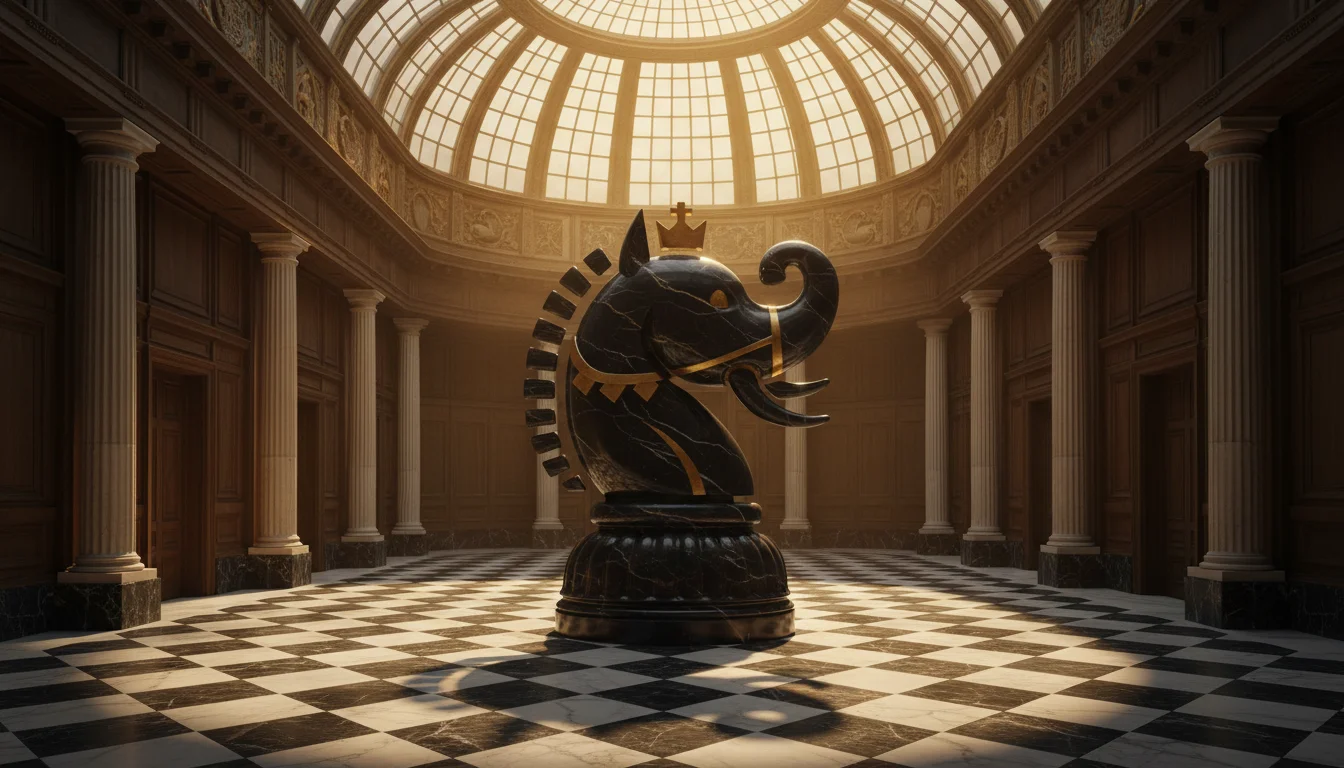
If the expanded board creates a richer spatial problem, the Clone piece — BigChess's central innovation — creates a uniquely complex spatial challenge that has no classical analogue.
The Clone combines two fundamentally different geometric movement types in a single piece:
- Bishop movement: slides any number of squares diagonally, constrained by blocking pieces, operates on a single color for any given move
- Knight movement: jumps to a square that is two squares in one direction and one in another, ignores blocking pieces, alternates between light and dark squares
These two movement types embody different geometries. The bishop operates in a smooth, continuous diagonal geometry — its reach is blocked by physical obstacles but its path is geometrically clean. The knight operates in a discontinuous, jumping geometry — it can pass over obstacles, attack unexpectedly from indirect angles, and cannot be blocked by interposing pieces.
When these two geometries are combined in the Clone, the spatial problem it poses is not simply the sum of the two. It is multiplicatively more complex, because the player must simultaneously evaluate:
- What squares can the Clone reach using bishop movement?
- What squares can the Clone reach using knight movement?
- Which of these movements best serves the current positional needs?
- How does the choice between bishop-movement and knight-movement affect the Clone's future spatial options?
- How does the Clone's position interact with friendly and enemy pieces using both of its movement geometries simultaneously?
This is a qualitatively different spatial calculation from anything in classical chess. In classical chess, each piece has a single, well-defined movement geometry. Players develop spatial intuitions for each piece type — the "long-range" vision needed for rooks and bishops, the "local control" awareness needed for knights, the "all-directions" calculation required for queens. But each piece demands only one type of spatial reasoning.
The Clone demands two simultaneously, in real time, with positional consequences that propagate across the entire board.
Clone Spatial Patterns: A New Vocabulary
Because the Clone is new, the spatial patterns associated with it have not been catalogued. Classical chess has a rich vocabulary of tactical patterns — pins, forks, skewers, discovered attacks, zwischenzug, deflection, overloading — all of which have names and standard forms that players learn and recognize. Each pattern is, at root, a spatial pattern: a specific geometric configuration of pieces that creates a tactical opportunity.
The Clone introduces new spatial patterns that don't yet have widely agreed names:
- Clone fork via knight-jump: The Clone leaps to a square from which its knight movement attacks two enemy pieces simultaneously — impossible for a bishop, unexpected for a "bishop-like" piece
- Clone battery with bishops: A Clone and a bishop aligned on the same diagonal, creating double diagonal pressure — analogous to a rook battery on a file but operating across a diagonal
- Clone overreach: Using the Clone's long diagonal movement to cross the board and then pivoting to knight-move attacks at close range — combining long-range and close-range threat in a single piece
- Clone outpost domination: Placing the Clone on a central square supported by pawns where its knight-move reach covers critical squares that enemy pieces cannot easily contest
Recognizing these patterns requires developing a new spatial vocabulary — exactly the kind of active spatial learning that classical chess can no longer provide to experienced players whose pattern libraries are already fully formed.
Why BigChess Develops Richer Spatial Reasoning
The cognitive argument for BigChess as a tool for spatial development rests on a straightforward principle: you develop spatial reasoning by solving spatial problems you haven't encountered before.
A classical chess player who has studied the game for years is not developing new spatial thinking when they play. They are applying established spatial patterns to new instances of familiar situations. This is a valuable skill, but it is not spatial exploration — it is spatial recall.
BigChess, because its spatial landscape is genuinely new, forces genuine spatial exploration. Every game on the 10×10 board with the Clone confronts players with geometric configurations they haven't seen before, requiring them to reason from first principles rather than from pattern memory. The Clone's dual movement geometry demands simultaneous spatial tracking of two different movement types. The triple pawn step creates pawn structures that require spatial analysis without the guidance of established theoretical knowledge.
This is not a claim that BigChess will make classical chess players worse at classical chess — there is no reason to believe that. The spatial skills developed in BigChess are extensions and expansions of the spatial skills that classical chess develops, not replacements for them. A player who becomes comfortable with Clone geometry will bring richer spatial awareness to classical chess positions involving bishops and knights, because they have thought more deeply about both movement types and their interactions.
But the deepest benefit is for players who have hit the ceiling of classical chess's spatial learning curve — who feel that they are no longer genuinely exploring geometry, merely applying what they already know. For those players, BigChess offers a new spatial frontier.
The 10×10 Board as a Mirror of Complex Reality
There is a philosophical argument for the 10×10 board that goes beyond chess improvement. Chess has always been used as a metaphor for strategic thinking, and its reputation rests on the claim that it genuinely develops real-world cognitive skills — not just chess skills, but the ability to think ahead, to visualize complex systems, to make decisions under uncertainty.
If that claim is true, then a richer, more complex chess variant should be a richer cognitive tool. The spatial problems on a 10×10 board with a Clone are closer in complexity to the spatial problems of real strategic thinking — managing more variables, tracking more interactions, maintaining coherent plans across a wider operational theater — than the more constrained problems of the 8×8 board.
This is not a claim that BigChess players will become better generals or better chess players. It is a claim that the kind of thinking BigChess demands — holding multiple spatial geometries in mind simultaneously, reasoning about complex piece interactions across a wide board, developing intuitions about genuinely new spatial configurations — is valuable in itself, and that BigChess offers it in a form that is both challenging and enjoyable.
Experience the Spatial Frontier at BigChess
BigChess was designed by Vilen Fatalov, a Ukrainian entrepreneur and Candidate Master of Sport with over 40 years of chess experience. His goal was to create a game that recaptures the exploratory quality that makes chess genuinely educational — the quality of encountering positions you haven't seen before and being forced to think your way through them.
| Feature | Classical Chess (8×8) | BigChess (10×10) |
|---|---|---|
| Board squares | 64 | 100 |
| Longest diagonal | 8 squares | 10 squares |
| Piece movement geometries | 5 distinct types | 6 distinct types (incl. Clone) |
| Maximum pawn advance from start | 2 squares | 3 squares |
| King castling distance | 2 squares | 3 squares |
| Opening theory depth | Extensively catalogued | Terra incognita |
Play BigChess with ELO matchmaking, sharpen your spatial thinking with BigChess puzzles, and review your games in the full game history. Available on web, iOS, and Android.
Your spatial thinking deserves a bigger board. Play BigChess at bigchessgame.com.
About the Author
Marat Fatalov
Co-inventor of Big Chess
High School Student, Co-inventor of Big Chess, Second Category chess player.